

Gorrin
(Half-Successful Origin Breed — Savage Humanoids of Cezorus)
Origin:
The Gorrin were one of the Elder Races’ final attempts to design a servitor species capable of endurance, obedience, and adaptability. Intended as labourers and soldiers who could survive unstable leyfields and harsh conditions, the Gorrin proved physically ideal — strong, durable, and fast-healing — but intellectually flawed. They exhibited unpredictable aggression, limited comprehension, and a volatile group psychology. When the Elder dominion fell, containment collapsed, and the Gorrin scattered across Aesos. Over millennia, they reverted to instinct, forming tribes that survive by scavenging and raiding the remnants of the world that created them.
Appearance
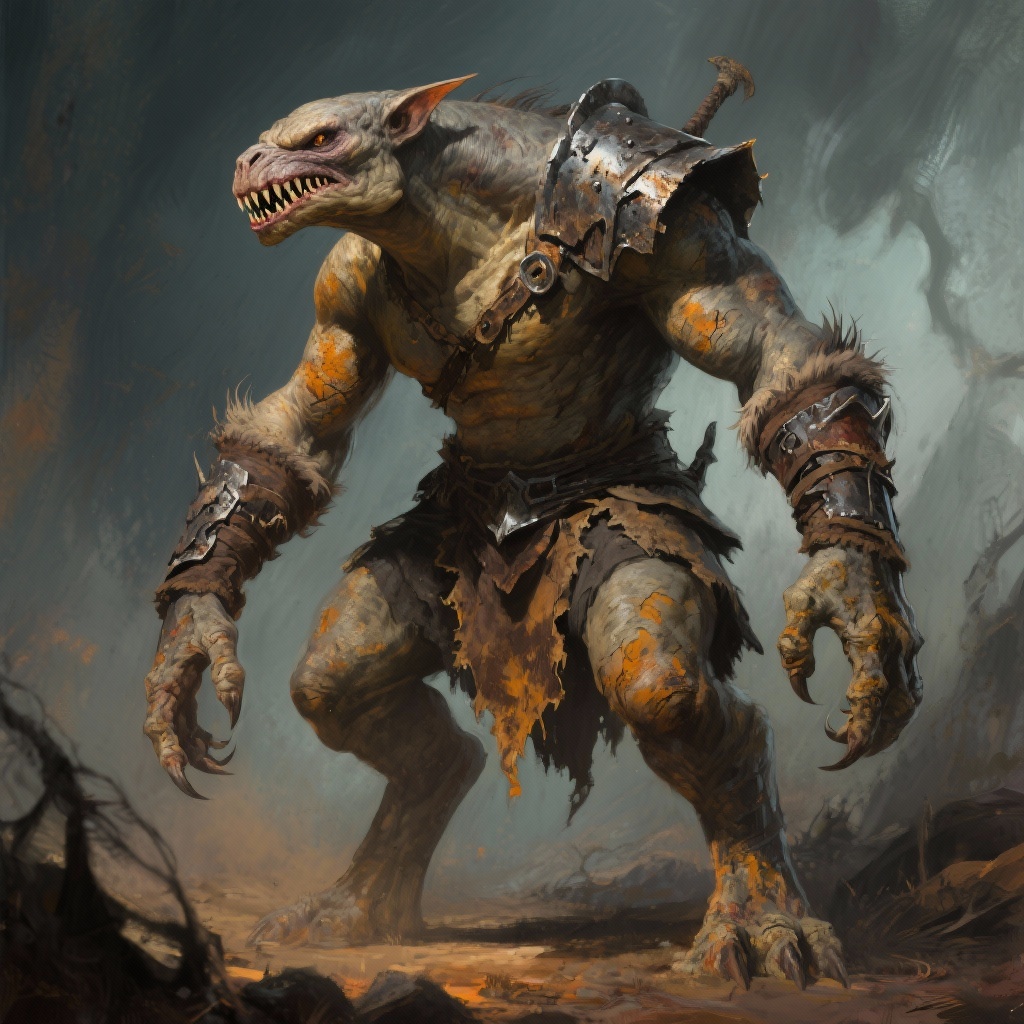
- Human-sized but heavier and more muscular, with elongated, powerful arms and compact, sturdy legs.
- The posture is upright and confident, suggesting brute power restrained by instinct.
- The face is recognisably human but subtly wrong — the skull slightly extended forward into a short, muzzle-like structure that lends a predatory cast to the mouth and jaw.
- Brow heavy and pronounced; nose flat and broad; lips thin over blunt, uneven teeth.
- Eyes small, deep-set, and expressive — calculating rather than mindless.
- Skin coarse and weathered, mottled in grey, ochre, or brown tones, with rough callused patches along the forearms and shoulders.
- Sparse bristle-like hair along the jaw and neck; no fur or animal traits beyond the altered bone structure.
- Typically clad in scavenged armor of leather, hide, or metal scraps, armed with crude but functional weapons.
Behaviour & Temperament
- Aggressive opportunists, motivated by dominance, hunger, and superstition.
- Prefer ambushes and swarm tactics; coordinated yet instinctual rather than strategic.
- Territorial but not xenophobic — they will ally temporarily with humans, bandits, or other monsters if there’s mutual gain.
- Communicate through rough speech, snarls, and gestures. Some tribes mimic human words for intimidation.
- Known for pounding their arms or chests before battle, producing booming sounds that rally their kin.
- Cannibalism and dominance rituals are central to Gorrin culture: the defeated are devoured or branded, reinforcing strength through conquest.
Society & Structure
- Smallest unit: gang (5–15 Gorrin), usually following a dominant fighter or “Basher.”
- Multiple gangs form temporary tribes under a Warchief or Ironhide. Such alliances dissolve as soon as leadership weakens.
- Females and young remain hidden in burrows or caves during raids; breeding rates are high, ensuring constant population pressure.
- No true craftsmanship — all tools and weapons are scavenged or repurposed.
- No written language; crude symbols mark territory and communicate threats.
Varieties
- Hill Gorrin: Common across Cezorus’s interior. Adaptable, cunning, and aggressive.
- Swamp Gorrin: Found in the southern Dead Mere; sallow-skinned, with a taste for ambush and net traps.
- Stone Gorrin: Mountain-dwellers with denser bones and thicker skin, often leading assaults on mining operations.
- Ash Gorrin: A rare desert offshoot with dark, heat-resistant skin and scavenged armour of bone and bronze.
Champions & Mutants
Occasional leyline surges or inherited instability produce exceptional Gorrin:
- Ironhides: Massive, thick-skinned brutes who act as tribal warlords.
- Wyrdheads: Deformed mystics with limited ley sensitivity, capable of strange shamanic displays.
- Bloodmaws: Battle-frenzied killers whose veins darken and eyes burn with ley-reactive energy during rage.
Relations with Civilized Lands
- The Gorrin are a known and catalogued species within Cezorus — officially classified as Monstrous Humanoids.
- Gorrin gangs are a common training ground for adventurers and local militias.
- The Cezorian military periodically conducts Suppression Campaigns to dismantle large tribes before they threaten trade routes or settlements.
- Adventurers often take bounty contracts to eliminate smaller gangs near villages or roadways.
Cultural Notes
- Fear and reverence for ley phenomena — they call it “sky blood” and treat thunderstorms as omens.
- Decorate their bodies and weapons with crude symbols carved or branded into flesh.
- Some tribes keep human relics or bones as “memory charms,” believing they steal a measure of human cunning by possession.
- The Gorrin see humanity not as prey, but as rivals — a species that “stole their place” in creation.
