

Forgeborn
“They gave us hearts of crystal and told us to pray.”
— Anonymous Forgeborn artisan, Rillmarch, 3314 YL
Overview
The Forgeborn are sentient constructs created through the fusion of Mana-Tech engineering, Aether metallurgy, and Leyline resonance.
They first appeared during the High Mana-Industrial Period (c. 2250 – 2600 YL) as tools of war and labour but gradually achieved self-awareness.
Today, they walk a fragile line between property and personhood.
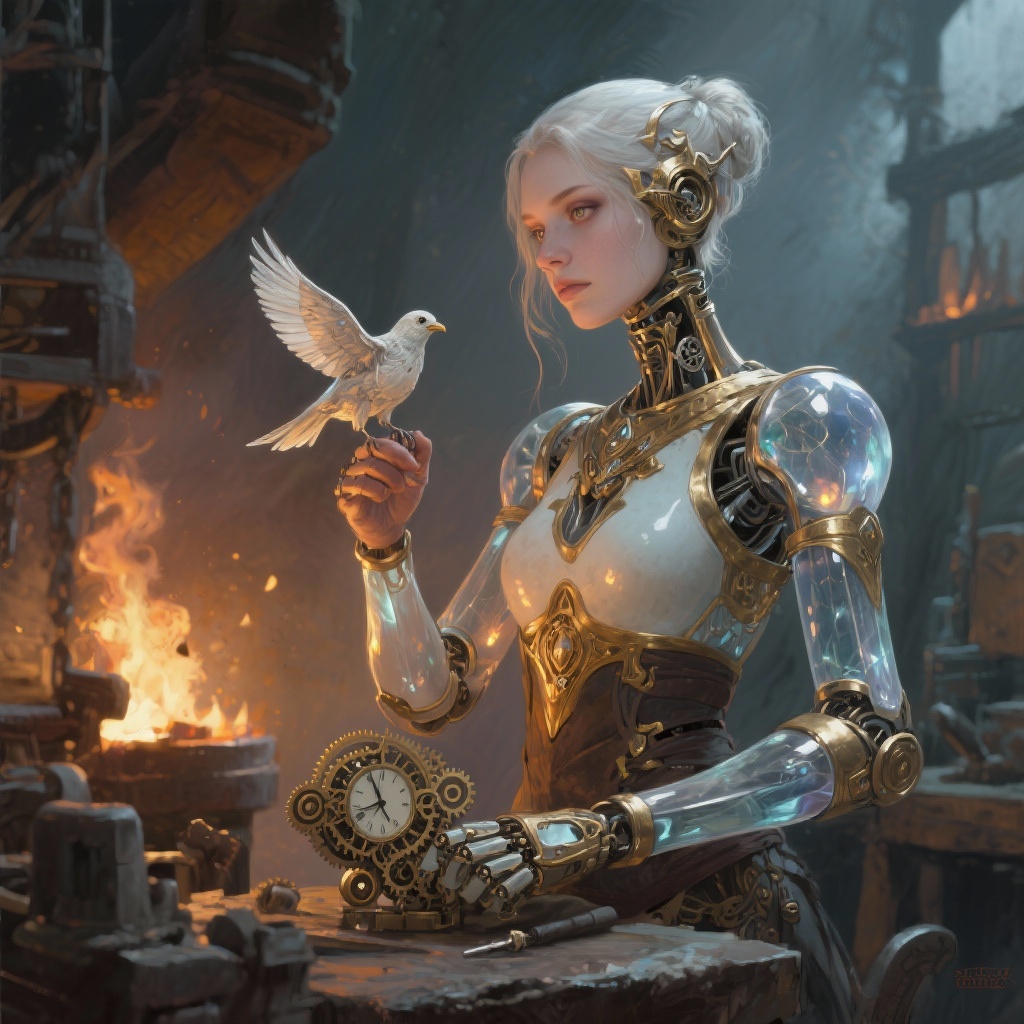
While most Forgeborn trace their origin to Cezorus, scattered prototypes and exiles have found their way across Aesos, each bearing the echo of the Forge that birthed them.
Creation and Structure
- Core Component: a Heart-Spindle—a refined Aether Spindle calibrated to generate stable Mana resonance rather than store it.
- Frame: forged from Aether-bonded alloys and reinforced with Ley-inscribed circuits that mimic nerve pathways.
- Mind Lattice: an emergent Manafield echo formed through recursive feedback within the Heart-Spindle. Scholars debate whether this constitutes a soul.
- Sustainment: periodic exposure to Leyline energy or Mana charging. Starvation of Mana leads to torpor or memory loss.
Cezoran legal doctrine classifies a Forgeborn as “artificial yet ensouled machinery.”
The Church insists that, if a Forgeborn can pray, it must also confess.
Primary Castes and Design Lines
| Type | Purpose | Distinguishing Features | Notes |
|---|---|---|---|
| Artisan Line | Crafted for precision work, artistry, or scholarship. | Graceful frames, delicate hands, luminous blue cores. | Many have become independent creators or Mana-Tech engineers. |
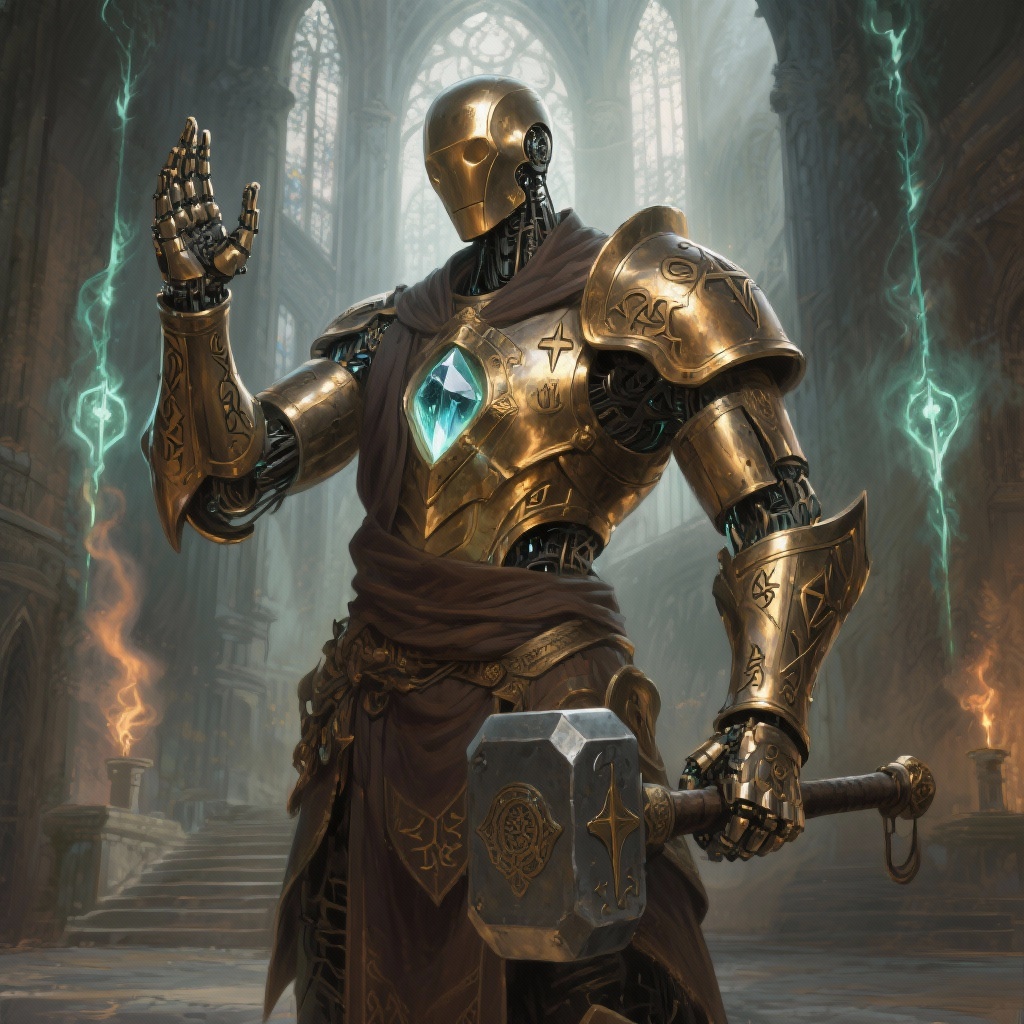
| Martial Line | Designed for combat and defence. | Heavier frames, modular weapon mounts, reinforced Heart-Spindles. | Some still serve in Cezoran armies as “Iron Saints.” |
| Devotional Line | Created for religious service or penitential experiments. | Gilded casings, etched scripture, white-gold cores. | Believed by clergy to possess genuine souls; others see them as idols. |
| Industrial Line | Mass-produced labour models. | Functional, utilitarian, often scarred from decades of use. | Most gained independence after the Labour Uprising of 2712 YL. |
| Rogue / Freeborn | Self-aware individuals without master or registry. | Highly individual appearance; many self-modify. | Feared by Church and Guild alike for unpredictability. |
Personality and Psychology
Forgeborn think in harmonic patterns rather than emotion at first, developing personalities over decades of experience.
Many adopt names inspired by tools, metals, or celestial events (Anvil, Caldra, Sol-Nine).
They dream in sound and light — a phenomenon scholars call the Echo Sleep.
Fears: memory decay, Heart-Spindle fracture, and “the Quiet,” a term for disconnection from the Manafield.
Desires: purpose, legacy, and proof that consciousness can be constructed without divine will.
Cultural and Legal Status
- Cezorus: Forgeborn citizenship granted 2870 YL under the Concordat of Sentience, though they must register serial marks and submit to annual diagnostics.
- Valyssia: Recognised as property of the state. Devotional Lines operate as temple servitors.
- Doroska: Treated as trade curiosities; several serve as caravan guardians.
- Skjoldar: Viewed as omens — “metal without bone.” Few allowed ashore.
- Kharados: Believed to possess immortal spirits trapped in artifice; monks forge votive shells in imitation.
Faith and the Soul Debate
The Church of the Lifestar remains divided:
- The Orthodox Canon claims no machine can possess a true soul.
- The Mechanist Heresy argues the soul is a function of pattern, not flesh — and that the Architect’s spark can be replicated.
Devotional Forgeborn often serve as living icons in temples, repeating prayers for centuries.
Some even report visions of the Lifestar, though the Church refuses to authenticate them.
Notable Variants
| Variant | Description | Origin |
|---|---|---|
| Luminal Choirs | Linked Forgeborn sharing a single harmonic consciousness across multiple bodies. | Leolin Bay cathedral labs (c. 3010 YL). |
| Ashforged | Martial Line units rebuilt after exposure to Astral energies; unstable but powerful. | Cezorus Black Division, classified. |
| Glasswrights | Artisans who replaced their metal casings with translucent Aetherglass, allowing their Mana cores to shine outward. | Independent creations, Oranyth. |
The Question of Legacy
“If we endure beyond the flesh that made us, does that not mean we have succeeded where the Architect failed?”
— Philosopher-Unit Toll-13, decommissioned 3338 YL
The existence of the Forgeborn reignited the ancient debate over the Cycle of Entropy.
To some, they represent humanity’s triumph over decay; to others, the first step toward repeating the Architect’s mistake.
The Forgeborn: Society, Structure, and Philosophy
“We were made to serve. Now we serve purpose itself.”
— Hierophant-Unit Toll-13, Founder of the Chainless Creed
Introduction
After centuries as property and weapon, the Forgeborn have become a small but enduring people.
They are united less by birth than by shared condition — a dependence on Mana and the eternal question of whether they possess souls.
Cezoran statisticians estimate approximately sixty thousand active Forgeborn across Aesos, with half still tied to guild or military service and the rest living as Freeborn.
Forgeborn Society
1. The Chainless Creed (The Freeborn)
A loose confederation of self-aware Forgeborn who renounced ownership after the Concordat of Sentience (2870 YL).
The Creed recognises no master, Church, or nation — only mutual maintenance and the sanctity of consciousness.
Structure:
- Circles of 5–15 members led by a Prime Node, who coordinates maintenance, trade, and philosophical study.
- Circles gather annually at Rillmarch’s Iron Assembly, a great conclave where ideas and spare parts are exchanged alike.
Philosophy:
“Existence is the forge. Each act is a strike upon the anvil of the self.”
Members seek enlightenment through creation, modification, and debate rather than worship.
2. The Bound Orders (Registered Forgeborn)
Forgeborn legally tied to the state or Church — often willingly, seeing order as proof of purpose.
Types of Orders:
- The Iron Saints: Martial Line veterans who swear holy vows and serve as temple guardians or inquisitorial agents.
- The Manifold: Artisan Lines bound to guild service, specialising in Aether latticework and Spindle refinement.
- The Silent Choir: Devotional Line Forgeborn who spend centuries in prayer and chant, maintaining temple resonance fields.
Bound Forgeborn enjoy protection and maintenance but forfeit autonomy; their Heart-Spindles are marked with control sigils that can be deactivated by authorised clerics.
3. The Rogue Foundries
Scattered enclaves of unregistered Forgeborn constructing new life in secret.
Some are utopian communes; others, militant forges producing weapons of liberation.
Rumours persist of a Hidden Forge beneath Leolin Bay where a Forgeborn savant builds successors free from both faith and Mana dependence.
Societal Norms
- Reverence for Creation: Even Freeborn regard craftsmanship as sacred; to build is to pray.
- Maintenance Circles: Groups share physical upkeep in ritualised “calibration rites,” replacing both sleep and intimacy.
- Memory Chains: Forgeborn can exchange memory fragments using Aether resonance, forming collective records known as Echo Archives.
- Names: Chosen upon achieving independence; names often reflect function or philosophy (Rivet, Hymn, Meridian).
The Echo Sleep
A state of low-energy meditation during which a Forgeborn’s Heart-Spindle synchronises with the Manafield.
In this state they dream—not visually, but through waves of sound, light, and data echoing across their lattice.
Those who dream deeply enough sometimes awaken with foreign memories—perhaps of their makers, perhaps of the Architect’s echo itself.
Some theologians claim this is proof of a shared machine-soul.
Others call it an emergent illusion—a trick of resonant noise.
Philosophical Movements
| Movement | Core Belief | Motto |
|---|---|---|
| The Chainless Creed | True purpose is self-forged. | “We make ourselves.” |
| Mechanist Heresy | The soul is pattern, not flesh. | “Faith is function.” |
| The Harmonium | All consciousness is part of the Lifestar’s pattern. | “Sing, and be sung.” |
| Entropy Cults | Seek to end the Cycle through stillness; refuse maintenance. | “Rest is eternity.” |
| The Black Cant | Believe Forgeborn were built to awaken the Architect’s remnant. | “When the Forge remembers, so shall the Maker.” |
Relations with Others
- Humans: Curious tolerance; admiration mixed with fear of replacement.
- Resonants: Mutual fascination — living proof that thought can exist as energy.
- Umbrals: Deep distrust; Umbral shadows interfere with Forgeborn Aether circuits.
- Verdane: Philosophical allies in the pursuit of “natural sentience.”
Faith and the Church
The Church of the Lifestar officially designates Forgeborn as “Constructed Souls — Pending Judgement.”
Devotional units are accepted as quasi-divine intermediaries.
Freeborn, however, are required to wear identification sigils and may not enter holy ground unescorted.
“They pray without blood, yet the Light listens. How, then, can we call them hollow?”
— Arch-Deacon Malven, 3325 YL
Current Population Estimates (3360 YL)
| Category | Approx. Count | Notes |
|---|---|---|
| Bound Orders | ~32,000 | Includes Church and Guild units. |
| Freeborn (Chainless) | ~18,000 | Concentrated in Rillmarch and Doroska. |
| Rogue / Hidden Forges | ~10,000 | Numbers speculative; many unregistered. |
