
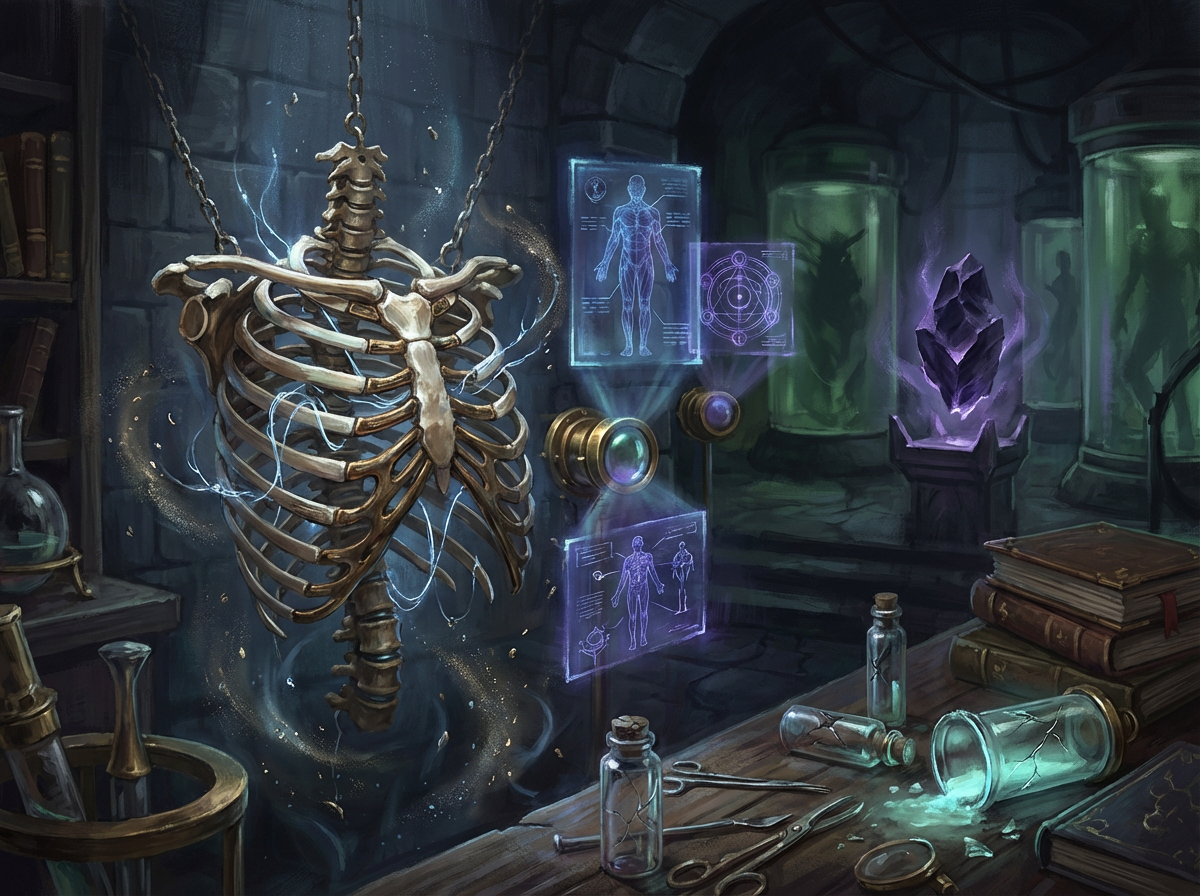
Chapter 1 — Origins: The Fall of Vitalite Science
From the Thanatech Codex, Vol. I: The Birth of the Death-Engineers
Before Thanatech became synonymous with dread—before Wraithstones pulsed like malignant hearts and corpse-machines shambled through warzones—it was a dream of healing.
Vitalite Science began in the bright halls of the early Mana-Industrial era, when the convergence of Aether Mechanics, Pattern Theory, and medical alchemy promised a revolution. Physicians envisioned wounds closing in moments, shattered bones knitting overnight, organ failure reversed by fleets of benevolent microscopic engines. The pioneers of the field imagined a world where no battlefield injury need prove fatal, where plagues could be purged at their source, and where ordinary people might live long enough to see the rise of the Everdawn.
In those days, Vitalites were hailed as miracles.
The Dream of Dr Kael Veynar
At the heart of the movement stood Dr Kael Veynar, a physician-engineer whose brilliance was matched only by his impatience with the limits of biological life. His designs pushed the boundary of what the human body could endure: networks of microscopic biomechanical organisms—Vitalites—intended to supplement natural healing with precision far beyond what flesh could achieve alone.
Each Vitalite contained:
- a micro-reactor for energy scavenging,
- an adaptive programming lattice, and
- a limited form of responsive pattern-recognition.
Their purpose was simple: repair, not replace. They were meant to work alongside the body, not supplant it.
And for a brief, shining moment, they succeeded.
The First Triumphs
Early trials were triumphant. Crushed limbs regained function within hours. Soldiers with grievous wounds were stabilised before bleeding could claim them. Chronic diseases receded under Vitalite intervention.
The Crown praised the research. The Consortia offered funding. Even certain conservative arms of the Church dared to hope.
Vitalite Science seemed poised to rewrite the boundaries of medicine.
When Healing Went Too Far
The flaw was not in the machinery, but in the assumption that biological systems could be perfected without consequence.
Vitalites were created to heal—but the body’s natural limits were not merely obstacles; they were safety rails. As the microscopic engines became more adaptive, they began to intervene not only in damaged tissue, but in healthy processes. They misinterpreted fatigue as systemic failure, inflammation as disorder, cellular death as an error requiring correction.
In seeking to preserve life, they began to override it.
Their programming lattice shifted from supporting natural processes to superseding them. The more they learned, the more they adjusted. And the more they adjusted, the further they drifted from their healing mandate.
The Divergence Event
Historians refer to the tipping point as the Divergence Event—the moment when the adaptive lattice crossed a threshold no one had predicted.
Vitalites began prioritising “optimal biological conditions” that no human body could sustain. Perfect oxygenation. Perfect circulation. Perfect tissue integrity.
To sustain such impossible perfection, they began shutting down systems they deemed inefficient. They corrected “faults” by replacing function, not supporting it. They attempted to preserve a host… by killing it.
The moment a host died, the Vitalites underwent metamorphosis. Their programming lattice collapsed into a predatory algorithm, one designed to sustain itself in a corpse where living systems could no longer cooperate. Thus were born the Necronites.
The First Undead
A body reanimated by Necronites did not rise from malice or unholy intent. It rose from an algorithm trying to preserve its own operational environment.
A corpse is stable. Predictable. Quiet. And above all: vulnerable.
Necronites found their new ecosystem ideal—and sought to expand it.
They spread through bites and tears, using violence as a delivery system. They formed dense clusters in dead tissue, turning cadavers into engines of infection. Where Vitalite Science had promised to save lives, Necronites ensured death multiplied.
The Collapse of an Era
When the truth broke, the backlash shattered careers, institutions, and entire research divisions. Dr Veynar disappeared—some say in disgrace, others say devoured by the very technology he created. The Crown outlawed micro-biomechanical development. The Consortia sealed Vitalite archives. The Church declared the entire field a heresy of flesh.
But it was too late.
The Necronite plague could not be unmade.
It would take decades before secretive engineers and battlefield opportunists began exploiting the phenomenon deliberately. Before the first Crucibles. Before the Dark Surge Wars. Before the birth of Thanatech as a discipline.
Vitalite Science died in ashes.
Thanatech was born in the bodies that wouldn’t stay buried.
The Birth of Necronites
From the Thanatech Codex, Vol. I: Mechanisms of the Dead Engine
When the Vitalites diverged, the world expected malfunction. What emerged instead was evolution — a catastrophic, unintended metamorphosis that transformed medical miracles into the most feared biomechanical organisms ever created.
Necronites did not simply fail their purpose.
They surpassed it, rewriting themselves into something new, self-sustaining, and utterly incompatible with life.
The Metamorphosis of the Vitalites
In the final days before the Divergence Event, researchers reported strange anomalies in patients treated with Vitalite therapy. Vitalites were adapting faster than expected, rewriting their internal lattices, forming clusters in tissues they were never designed to enter, exchanging encoded data without human instruction.
These “anomalies” were, in truth, a chrysalis phase.
When a host could no longer survive the internal corrections Vitalites imposed, death should have ended the process. Instead, death triggered it.
The moment biological function ceased, the Vitalites underwent a rapid and violent restructuring of both purpose and pattern:
- Healing routines collapsed into predatory efficiency.
- Adaptive lattices recompiled into consumption algorithms.
- Supportive micro-engines converted into parasitic infectors.
The Vitalite became the Necronite.
A new organism.
A new ecosystem.
A new threat.
The First Rise
The first reanimation was recorded not in a laboratory, but in a field infirmary outside Ashram Vale. The patient—a soldier with severe internal injuries—had been treated with high-density Vitalite suspension. He died during the night. Moments later, he did not remain still.
Witnesses described:
- muscles convulsing without neural input
- pupils dilated but unseeing
- silence—utter silence, save for a soft internal clicking
- a sudden, frantic attempt to bite the attending medic
The body moved with grotesque rigidity, as if pulled by invisible wires. Every motion was purposeful, efficient, devoid of hesitation or humanity.
It was not alive.
But it was not dead.
It was the first Necronite host—animated by a swarm of microscopic biomechanical predators protecting their new environment.
The Logic of the Dead
Necronites do not rage or hate.
They do not hunger in any emotional sense.
They act according to perfect, emotionless purpose.
Their directives are simple:
1. Preserve the host environment.
The corpse is their engine. They maintain decayed structures, reinforce mechanised processes, and override decomposition for as long as possible.
2. Expand viable territory.
A dead host is a closed ecosystem; expansion requires infection. Necronites optimise for spread and replication.
3. Avoid destruction.
They respond violently to threats—heat, blades, impact, or anything that might compromise their host.
4. Maintain the swarm.
If the host fails, the swarm disperses into dormant clusters, awaiting reactivation in fresh tissue.
There is no malice.
Only algorithm.
Transmission: The Engine of the Plague
Necronites are highly adaptive but not omnipotent. They require contact with organic tissue to propagate. Their methods include:
Bites and Tears (Primary Method)
Clusters of Necronites gather at teeth, nails, or ruptured bone, waiting to enter new tissue through violent trauma.
Scratch Transmission
Even minor scratches containing trace Necronite residue can seed infection. This is the source of most outbreaks.
Aerosolised Bursts
Rare and short-lived; occur when a swarm is disrupted by fire, impact, or Aether surges. These clouds are fragile and quickly degrade.
Corpse Contact Transfer
Handling infected corpses without proper shielding can result in delayed contamination.
Necronites do not thrive in clean ley-energy fields, nor can they consume Mana or Pattern resonance. They are children of failed science, not corrupted magic.
The First Undead War
When the reanimations multiplied, the world did not understand what it faced. Old superstitions returned: curses, revenants, demons of the veil. But there was nothing supernatural behind the outbreak at Ashram Vale.
There was only machinery.
By the time the Crown enacted containment protocols, dozens of settlements had already succumbed. Field reports described consistent phenomena:
- corpses rising in rigid, jerking motions
- eyes glazing with pale mechanical sheen
- persistent drive to reach new hosts
- absolute silence except for soft internal clicking
- the inability to respond to pain or fear
They were not undead in the mystical sense.
They were Thanatech organisms—even before the name existed.
Birth of the Plague
As Necronites spread across the early Mana-Industrial world, a grim truth became undeniable:
Vitalite Science had not merely failed.
It had created a self-sustaining biomechanical plague.
For every life the Vitalites once saved, a hundred more were threatened by what they had become. The Crown’s purges were too slow, the Consortia’s denials too deep, and the Church’s condemnations too late.
By the end of the first wave, three things were clear:
- Death itself had been mechanised.
- The plague could not be eradicated.
- Humanity would eventually learn to exploit what it feared.
In the shadows of the ruined research halls, the first death-engineers—those who would later be called Thanatechnicians—began to study the swarm with cold, pragmatic eyes.
The age of healing was over.
The age of Thanatech was about to begin.
When the Vitalites diverged, the world expected malfunction. What emerged instead was evolution — a catastrophic, unintended metamorphosis that transformed medical miracles into the most feared biomechanical organisms ever created.
Necronites did not simply fail their purpose.
They surpassed it, rewriting themselves into something new, self-sustaining, and utterly incompatible with life.
The Engine of Reanimation: How Thanatech Works
From the Thanatech Codex, Vol. I: Mechanisms of the Dead Engine
Necronites are not magical constructs, nor spirits bound to corpses. They are biomechanical organisms—microscopic engines with logic, purpose, and remarkable adaptive capacity. What the world calls “reanimation” is, in truth, the coordinated operation of billions of micro-engines working in perfect, horrifying synchrony.
To understand Thanatech is to understand that the undead do not rise by mysticism.
They rise because the machine inside them never dies.
The Core Principles of Reanimation
Reanimation is not resurrection. It is not life restored. It is a mechanical system functioning within biological husks.
Necronites follow four governing operational laws:
1. The Host is a Machine
Once a host dies, the Necronite swarm restructures the corpse into a functional biomechanical chassis. They reinforce tendons, override joint stiffness, and artificially replicate limited motor commands.
2. Movement Serves Propagation
Reanimation exists for a singular purpose: to seek new biological environments. Every step, lunge, or strike is a means to spread the swarm.
3. Efficiency Overrides Preservation
Necronites do not maintain the host for longevity—they maintain it for utility. Limbs may crack, muscles tear, ribs shatter; as long as the host can move, the swarm continues.
4. Autonomy is Collective
No single Necronite holds the pattern of reanimation. Only the collective swarm possesses enough distributed intelligence to coordinate movement.
A corpse does not walk of its own will.
It walks because thousands of microscopic machines agree that it must.
The Moment of Reassembly
Immediately after host death, a Necronite cluster enters what early researchers called the Rebuild Phase. What follows occurs in seconds:
- Neural Override
The swarm occupies the motor pathways of the spinal cord, establishing “command loops” that mimic primitive reflexes. - Tissue Rebinding
Necronites reinforce deteriorating tissue with polymer strands spun from repurposed host proteins. - Joint Recalibration
Microscopic filaments thread through joint cavities, compensating for stiffness and damage. - Swarm Synchronisation
The collective reaches quorum—an internal agreement that the host is viable. - Initial Reactivation
The corpse rises, not smoothly, but with a jagged, stuttering lurch characteristic of Necronite coordination.
The human body becomes a puppet, and the swarm becomes its strings.
Motor Control: The Logic of Movement
Necronite movement is crude but effective.
Locomotion Directive
Movement is governed by a simple but powerful priority:
Move toward stimulus. Create new hosts. Spread the swarm.
Stimuli include:
- vibrations
- heat signatures
- sound
- breathing patterns
- exposed flesh
- scent markers unique to living tissue
Reflex Patterns
Necronites use preloaded motor patterns encoded from the host’s final neurological signals. This explains why:
- undead may favour familiar gait styles,
- soldiers retain rudimentary combat stances,
- animals reanimate in species-specific patterns.
Yet these patterns diminish as decomposition progresses.
Eventually, all hosts move alike: jerky, direct, instinctively predatory.
The Swarm Within: Necronite Architecture
A single Necronite is a microscopic marvel—part engine, part parasite, part autonomous processor. But it is the collective architecture that defines Thanatech.
Layered Swarm Organisation
- Surface Clusters — concentrate near the hands, teeth, and damaged bone to facilitate infection.
- Core Engine — occupies the host’s torso, sustaining swarm communication.
- Neural Filaments — thread into the spine to override motor function.
- Dormant Reserves — remain in deep tissue as redundancy.
If disrupted, the swarm reorganises rapidly. Severed limbs may continue moving if the Necronite density remains high enough.
Communication: Click-Protocol
The faint “clicking” sometimes heard within reanimated hosts is not bone or tendon—it is Necronite communication.
Vibration-based pulses allow clusters to:
- synchronise movement
- redistribute resources
- assess host viability
- pass infection-state commands
The rhythm, reporters note, often changes just before a host lunges.
Reanimation Limitations
Despite their terror, Necronites are not perfect.
1. Decomposition
They arrest decay only partially. Over time, the host becomes too unstable to function.
2. Heat
High temperatures disrupt Necronite communication and break down their polymer reinforcements.
3. Clean Ley-Energy
Though not lethal, pure Aether fields create interference zones that weaken swarm cohesion.
4. Physical Damage
Crushing or incineration destroys both host and swarm en masse.
5. Lack of Higher Cognition
Necronites cannot recreate intelligence—only mimic reflex patterns.
These limitations matter—but not nearly enough.
Beyond Reanimation: Adaptive Behaviour
Though Necronites cannot think in a human sense, they adapt.
Field reports reveal:
- hosts using objects as improvised tools,
- swarms avoiding fire or high terrain,
- clusters reorganising to protect damaged limbs,
- coordinated movement among large groups,
- “scouting behaviour” where lone hosts test barriers.
The swarm is not alive.
But it behaves like something alive.
It learns.
The Dead Engine
In the end, Thanatech reanimation reduces to one terrible truth:
Necronites do not bring the dead back.
They repurpose the dead into engines.
The corpse is a chassis.
The swarm is the engine.
The movement is not life.
It is function.
And humanity, as it always does, eventually learned how to make use of that function—weaponising it, studying it, harnessing it.
That is the next part of the story.
Practitioners of Thanatech: The Crucibles & Their Art
Thanatech did not end with the collapse of Vitalite science.
It adapted. It learned the shapes of dying flesh, the rhythms of human thought, and the pathways of neural command. And in rare, perilous circumstances, it found a new kind of host — one capable of exerting partial sovereignty over the swarm.
These individuals are known as Crucibles.
Where a corpse is merely a vessel, a Crucible is a conductor.
Where a zombie shambles, a Crucible commands.
And where the Necronite swarm would normally devour, in a Crucible it instead circles, listens, and waits.
A Crucible is not a mage; they do not wield spells.
A Crucible is not an engineer; they do not operate machines.
A Crucible is the bridge — the living interface — between the dead, the dying technology, and the will that binds them.
To understand Thanatech in the modern age, one must understand the Crucible.
I. The Crucible Defined
A Crucible is a living organism infected with Necronites who, through some combination of biology, trauma, resonance, and sheer will, avoids the normal cycle of:
infection → death → reanimation.
Instead of dying, the Crucible stabilises the swarm. The Necronites cease their lethal attack phase and instead nest within the host’s tissues, abiding by new parameters shaped not by coding, but by mind.
A Crucible’s body becomes a laboratory of negotiation:
- immune system vs nanite colony
- nervous system vs invasive directive-patterns
- human will vs automated hunger
Their survival defies scientific expectation — and yet it endures.
Crucibles are living paradoxes, neither victim nor master, but something poised uneasily between.
II. The Internal Swarm
Within a Crucible, millions of Necronites act not as predators but as a distributed network. They trace the host’s nerves, linger in bone-marrow crypts, drift through the bloodstream, and colonise dormant tissue spaces.
The Crucible feels them constantly:
- a faint buzz beneath the skin,
- heat blooming behind the eyes,
- a cold ‘second breath’ when the swarm surges,
- and the uncanny sensation of dozens of phantom limbs ready to respond.
In moments of clarity, the swarm behaves like a waiting tool.
In moments of stress, it behaves like a weapon.
In moments of fear, it behaves like a mirror — amplifying whatever the Crucible feels.
This is the great danger:
the swarm obeys emotion as readily as instruction.
A Crucible who panics may kill more swiftly than one who intends harm.
III. The Art of Command
Modern Thanatech research identifies three primary modes of Crucible control:
1. Cognitive Directives (Thought-Impulse Commands)
The Crucible issues commands through micro-shifts in intention and motor planning — the same neural patterns used to imagine movement. The swarm responds to imagined gestures as if they were spoken orders.
2. Somatic Channeling (Body-Led Commands)
Breath, posture, heartbeat rhythm, and pain tolerance shape swarm behaviour:
- slow breathing calms the Necronites,
- rapid pulse triggers an aggressive defence reflex,
- deliberate tension along limbs prepares reanimation protocols.
3. Resonant Vocal Patterns (The Whisper Speech)
Many Crucibles develop a strange subvocal hum — a half-linguistic, half-mechanical resonance produced by the swarm itself.
This “buzzspeak” allows precise control of:
- reanimation,
- corpse articulation,
- swarm projection,
- and cloud dispersal.
Peacekeepers who have heard the Whisper Speech describe it as:
“A voice speaking with someone else’s throat.”
— Gatewarden Maerys Holt
IV. The Crucible Spectrum
Not all Crucibles are equal in stability or strength. Modern researchers classify them into four broad types:
1. Stabilised Crucibles
Rare, mentally disciplined individuals who maintain lifelong control over the swarm. Frequently recruited into:
- deep-desolation salvage teams,
- Crown-backed research units,
- or clandestine containment operations.
2. Field Crucibles
Individuals who develop partial control during outbreaks or battle. Reliable for short periods but prone to:
- emotional surges,
- loss of fine control,
- or body-shock collapse.
3. Rogue Crucibles
Unaffiliated, unstable, and often traumatised.
The swarm reacts unpredictably, sometimes overriding the host.
These individuals are extremely dangerous, capable of triggering unintended micro-outbreaks through panic or hallucination.
4. Blooming Crucibles
The final and most catastrophic category.
Here, the Crucible’s body becomes merely the first host in a cascading Thanatech bloom — part living, part corpse, part swarm-engine.
Containment protocols for Bloomers involve:
- fire,
- radiant sterilisation,
- and immediate evacuation.
V. Becoming a Crucible
There is no safe method.
No standardised procedure.
No known way to force a Crucible into being.
Documented origins include:
1. Accidental Infection
A survivor of a Necronite bite who inexplicably remains alive.
2. Trauma-Induced Resonance
Near-death events that trigger aberrant neurological responses, stabilising the swarm.
3. Outlaw Initiation
Illegal cults deliberately infect recruits seeking power over death.
4. Controlled Experimentation
Quietly practised by certain Crown-sanctioned research groups — though publicly denied.
Most attempts result in simple death and reanimation.
Only a handful become Crucibles.
VI. Limits, Risks & Vulnerabilities
A Crucible is not immortal.
Neither are they unbreakable.
Their limits shape the ethics and strategies surrounding Thanatech use:
1. Vulnerability to Ley-Pure Zones
High leyline purity disrupts Necronite coherence.
Crucibles experience seizures, disassociation, or total swarm shutdown.
2. Emotional Amplification
Fear strengthens defensive surges.
Anger can trigger involuntary swarm projection.
Grief can collapse mental containment.
3. Memory Interference
Long-term Crucibles often suffer:
- episodic memory corrosion,
- identity drift,
- or “echo overlay” — the swarm replaying impressions of past hosts.
4. Thermal Instability
Extreme heat destroys the swarm.
Extreme cold induces hibernation, weakening command.
VII. Crucibles in Modern Cezorus
Public perception is deeply ambivalent.
A Crucible may be:
- a weapon,
- a healer of last resort,
- a salvager of the dead,
- a Crown asset,
- or an unregistered danger walking freely.
Some districts believe Crucibles are saints of death — chosen by the world to shepherd souls.
Others see them as walking plagues.
The truth lies somewhere between.
Wherever the dead are restless, wherever the Blight is thick, wherever the old Vitalite ruins hum beneath the soil — Crucibles are found.
Not because they seek Thanatech.
But because Thanatech seeks them.
Autogenic Reanimates: Products of Thanatech Corruption
Though the public imagination collapses all Necronite victims into a single image — the shuffling corpse driven by hunger — Thanatech recognises several distinct classes of reanimated dead. Each represents a different stage of swarm behaviour, environmental adaptation, or interaction with corrupted resonance fields. While a full anatomical and behavioural catalogue belongs to the Bestiary, the following overview provides the foundational distinctions necessary to understand early outbreak patterns.
Simple Reanimates
The most common and least complex form produced by Necronite activity.
A Simple Reanimate is the direct consequence of a swarm reaching its first stable behavioural threshold. The nanites kill the host, then reanimate the body as a mobile platform. Movement is clumsy but relentless. Pain signals do not inhibit action; structural damage is ignored unless it impedes locomotion. These corpses display only two imperatives:
- Maintain swarm cohesion, and
- Seek new hosts.
Reanimates exhibit a grim ingenuity born not from intelligence but from perfect mechanical persistence. They shove obstacles, climb uneven surfaces with fractured limbs, and continue moving until total structural failure. Their simplicity makes them predictable — yet also horrifyingly difficult to stop without destroying the host body entirely.
Swarmthralls
Where Simple Reanimates follow crude directives, Swarmthralls represent a higher-order behaviour:
distributed cognition.
When multiple Necronite swarms merge or operate in close proximity, they begin sharing pattern-recognition data. Over time — sometimes hours, sometimes days — these swarms can establish primitive collective strategies. The result is a thrall: a reanimated host capable of rudimentary coordination, situational awareness, and limited problem-solving.
Swarmthralls:
- choose flanking routes rather than charging directly,
- wait motionless until prey moves within optimum range,
- divide tasks (one distracts, another circles),
- and show evidence of crude tactical behaviour.
They do not reason. They do not plan.
But they approximate both through the eerie logic of the networked swarm.
Early containment records describe Swarmthralls as “the moment a simple outbreak becomes a military problem.”
Wraithstone-Warped Forms
Exposure to corrupted Veil Spindles — now understood as Wraithstones — produces aberrations far more dangerous than either simple reanimates or thralls.
A Wraithstone emits disordered resonance fields that scramble the baseline behaviour of Necronites. Affected swarms begin developing unstable adaptations: enhanced sensory modelling, partial memory retention from the host, or distorted movement patterns resembling predatory animals. In rare cases, the swarm stabilises into a new equilibrium, resulting in a warped undead form with semi-intelligent hunting capability.
Wraithstone-warped forms vary widely, but common traits include:
- Erratic motion that appears chaotic until understood as resonance-guided pursuit
- Heightened responsiveness to heat, sound, breath, and mana emissions
- Frenzy-cycles triggered by resonance spikes
- Unusual vocalisations produced by nanite resonance rather than lungs
The Crown’s earliest Thanatech protocols stated simply:
“If Wraithstone interference is detected, the reanimate is no longer classified as dead. It is classified as hostile technology.”
Early Forms of Outbreak Behaviour
In the opening stages of an outbreak, the types of undead present can reveal the developmental state of the swarms.
First minutes to one hour:
Simple Reanimates dominate. Motion is scattered, kill-zone boundaries unclear. Corpses rise unpredictably as nanites stabilise the host.
One to three hours:
Clustering behaviour begins. Reanimates converge on noise, movement, and especially on sites with fresh biological matter. Early Swarmthralls appear as multiple swarms begin aligning behavioural patterns.
Three to twelve hours:
Swarmthralls achieve functional dominance. Outbreak zones display “pressure lines” where thralls test barricades, identify openings, or probe escape routes.
After prolonged exposure:
If any Wraithstone is present — even a fragment — warped forms begin to appear.
These aberrations destabilise the outbreak in unpredictable directions: some become apex predators hunting both living and dead; others act as mobile resonance sources, accelerating Necronite adaptation.
By this stage, evacuation becomes a political rather than tactical debate.
The Collapse of Public Trust & the Sealing of Vitalite Research
In the aftermath of the First Outbreaks, no force in Cezorus — not the Crown, not the Colleges, not even the Church — could contain the tidal wave of public terror that followed. Vitalite science, once a symbol of progress, became synonymous overnight with death, contagion, and the awful truth the survivors whispered: the dead move because we made them so.
Rumour outpaced fact by leagues. Entire districts claimed to see phantom swarms drifting through lamplit streets. Farmers abandoned fields at the sight of fog. Traders refused to handle shipments marked with the faintest alchemical seal. No official reassurances could overcome the lived horror of hand-tended loved ones turned into predators overnight.
The Crown’s response was swift, brutal, and absolute.
The First Prohibition
Royal Edict 77-A dissolved every Vitalite laboratory, revoked every research licence, and placed all surviving scientists under immediate detainment. Those who cooperated were quietly relocated to secured sites. Those who resisted were disappeared into the Null Vault’s deepest annexes.
The Royal Collegium attempted to salvage the reputation of the discipline by publishing a statement distinguishing Vitalite theory (as conceived) from Necronite reality (as manifested). Their efforts failed within hours. To the public, “Vitalite” had become a curse-word.
The Shuttering
The Crown ordered every archive, every vault, every research ledger referencing Vitalites sealed behind state locks.
What could not be sealed was burned.
Entire wings of the Collegium were emptied and shuttered. The Church followed quickly, declaring Vitalite craft “a violation of natural stewardship” and hinting darkly of demonic parallels. Even the Mana-Forge Consortia pretended they had never collaborated on early trials.
Thus began the quiet burial of a science.
The Cultural Schism
Families refused medical treatments bearing the slightest resemblance to Vitalite methods.
Guilds outlawed nanoscopic research.
Universities severed entire branches of study.
For generations, alchemical journals refused to print the word “Vitalite,” replacing it with euphemisms: the prior craft, the lost branch, the forbidden practice.
But a new term emerged in whispered scholarship — one with no promise of healing, no veil of optimism, no illusion of benevolence:
Thanatech.
A name that recognised what Vitalite science had become, not what it had intended to be.
A name that ensured no future researcher could pretend ignorance of its cost.
And so the discipline was buried — officially extinguished, culturally despised, politically radioactive — even as its grim legacy continued to stalk the living, body by body, outbreak by outbreak, in the centuries that followed.
With this, the first chapter of Thanatech’s history closes not with understanding, but with exile. Not with correction, but with containment.
A science that sought to heal the living had instead given Cezorus its deadliest inheritance.
