Cathexis Wraith
Thanatech — Redeemer Tradition (Apex Psionic Catastrophe)
The ritual chamber was dark when the screaming stopped.
Not quiet — not truly — but hollow, as if the sound had been pulled into a space too vast to echo. The Redeemers stood frozen, their sigils burning uselessly on the stones, staring at the body on the floor.
It wasn’t moving.
It wasn’t breathing.
And yet the shadows around it rippled like ink disturbed by a sinking weight.
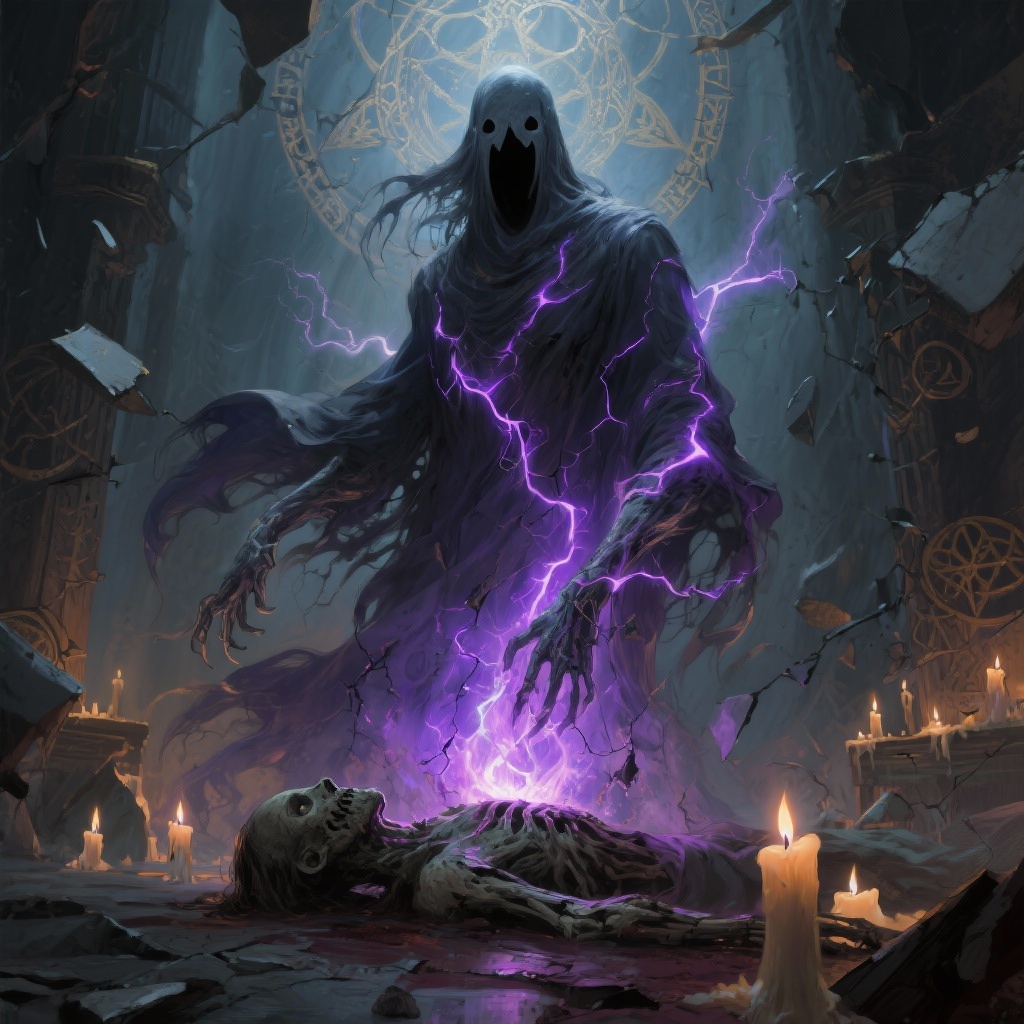
A shape rose slowly from the corpse — a distortion, a silhouette of grief and rage and unbearable pressure. Where its face should have been was a shifting hollow, a memory torn apart, a hole in the shape of someone who once lived.
When the Cathexis Wraith opened its mouth, the Redeemers heard their own memories crying out.
That was when they realised the soul had not returned.
It had broken free, dragging the Necronites with it into something that should never walk the world.
1. Classification
Apex psionic revenant; disembodied soul-construct hybrid; unstable, semi-immaterial Thanatech phenomenon originating from catastrophic Redeemer failure.
2. Titles
- Soul-Rupture
- Memory-Storm
- Hollow Ascendant
- The Screaming Echo
3. Appearance
A Cathexis Wraith is a terrifying fusion of soul-echo and Necronite projection:
- Form: Humanoid silhouette composed of roiling shadow-light and fractured psionic energy.
- Face: A hollow void or shifting mask of the host’s last emotional state.
- Body: Flickers between physical, semi-physical, and immaterial states; limbs distort or elongate.
- Veins/Aura: None — instead, arcs of psionic lightning trace through its shape like cracking glass.
- Core: A bright, unstable knot of violet-black Necronite-soul fusion at its centre.
- Movement: Gliding, flickering, sometimes appearing in several positions at once.
- Residual Body: The host corpse remains nearby, drained, collapsed, or partially erased.
Witnesses often describe it as “a memory that learned how to kill.”
4. Aspect
Detached Consciousness, Psionic Rupture, Unbound Emotion
5. Myth and Origin
Originates when:
- a soul violently resists redeemer anchoring,
- Necronites attempt to follow the departing psionic pattern,
- and both systems rupture catastrophically.
Instead of a revenant inhabiting the corpse, the psionic imprint tears free, dragging Necronite motes into a free-floating hybrid entity.
These beings were believed impossible until the Stillwater Incident; since then, at least six confirmed wraiths have been sighted across Cezorus.
They do not persist long — but their short existence is devastating.
6. Transformation / Creation
The process is rare and catastrophic:
- A soul refuses anchoring.
- Necronites entangle with psionic residue.
- Energy builds as the ritual collapses.
- The soul tears free, partially dissolving.
- The remaining echo fuses with swarm motes.
- The resulting creature manifests as a Cathexis Wraith.
Spontaneous formation can also occur near Wraithstones or corrupted Veil ruptures.
7. Abilities and Powers
- Psionic Tempest: Emits an expanding field of psychic agony, inducing panic, hallucinations, or unconsciousness.
- Memory Flensing: Extracts or corrupts memories of nearby living beings.
- Emotion Amplification: Forces overwhelming feelings (rage, grief, guilt) on targets.
- Phase Shift: Becomes intangible at will; physical attacks pass through harmlessly.
- Echo Strike: Manifests limb-like projections of psionic force.
- Soul Drain: Prolonged exposure weakens the victim’s noetic stability, risking coma or madness.
Weaknesses:
- Radiant grounding rituals disrupt psionic instability.
- Strong Verdant energies anchor and “weigh down” the wraith, limiting mobility.
- Destroying the corpse from which it rose weakens the core echo.
- Limited lifespan — most collapse within hours or days.
8. The Mark
- Local memories become unreliable or contradictory.
- Shadow “after-images” appear where the wraith has moved.
- Temperature drops sharply.
- Whispers in the victim’s own voice emerge from nearby darkness.
9. Behavior and Society / Culture
Cathexis Wraiths have no society and no desire for one — they are beings of instinct shaped by unresolved emotion.
Observed behaviours include:
- seeking out strong emotional signatures,
- returning to places of trauma,
- stalking individuals tied to the host’s final memories,
- drifting aimlessly when psionic reserves fluctuate.
They do not hunt for survival, but because pain seeks familiar shapes.
10. Religion and Doctrine
The Church considers Cathexis Wraiths the greatest of Redeemer abominations:
“souls torn from the path of the Lifestar and reshaped into storms.”
Redeemers study them as examples of why resurrection is forbidden —
but some extremist sects see them as gateways to understanding the mind beyond death, a belief always proven fatal.
11. In-World Fragments / Quotes
“It wasn’t angry.
It was grieving.
And everything it touched grieved with it.”
— Survivor, Coldmar Priory Incident
“A Cathexis Wraith does not kill the body first.
It kills the mind.”
— Scholar-Priest Arvel Thran
12. Scholarly Note or Speculative Analysis
Cathexis Wraiths stand as the ultimate warning of the Redeemer Tradition: consciousness cannot be forced back into matter without consequence. They are the violent recoil of a soul rejecting imprisonment, a storm of memory and pain animated by Necronites desperate to maintain a pattern they cannot comprehend.
They are short-lived, unstable, and catastrophic —
and they are proof that Thanatech can create horrors that defy both biology and metaphysics.