
The Pocket Thief
The thief entered the forest at dusk, where the air already shimmered with the metallic scent of rain. Behind him lay the last trace of the human world — the smoke of the town’s foundries, the smog-stained skyline — but before him, the trees were pale and whispering, their bark as smooth as polished bone. Every step sank into loam that pulsed faintly, as though the ground itself still had a heartbeat.
He had not come here by chance. The call of the silver bells had drawn him for nights now — faint chimes that rang just outside the reach of reason. They came with the cawing of crows that moved in perfect circles above his window, black feathers glinting with something more than oil, less than light.
He had told himself he would follow them only once, that he would turn back before the forest swallowed him. But the bells did not allow turning back. They were the kind of sound that curved the mind inward, that convinced one to step further and further into the dark, because surely there would be an end, surely there would be silence if one just reached the source.
The deeper he went, the more the air changed. There was a static pressure, like the pause before a storm, but colder. Leaves trembled without wind. Roots bulged underfoot, veined with lines of luminescent moss that glowed faintly when his boots brushed them. The thief wondered if this was light or merely the memory of light trapped in rot.
The forest was not meant for men. Everyone knew that. It was a Fey forest, a labyrinth of living things that remembered older bargains and hungered for newer ones.
Still, there were stories — of relics left by the Fey, of baubles with impossible worth. The thief had heard of the pockets they carried: small folds of impossible space stitched into fabric or skin, where treasures from countless worlds were hidden. He had heard, too, that stealing from the Fey was a kind of suicide.
But tonight, suicide sounded almost profitable.
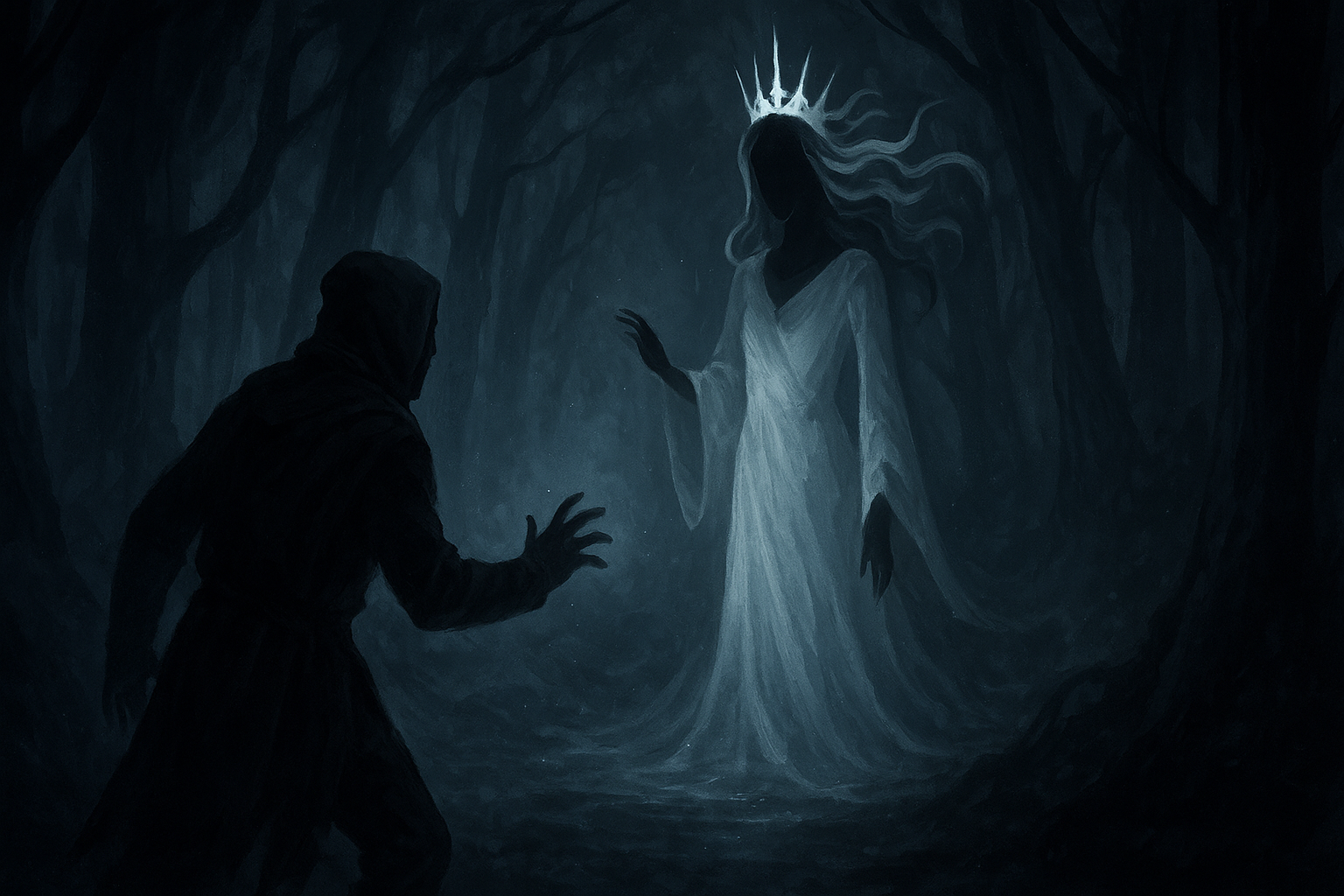
The chimes led him to a clearing shaped like an open palm. Silver mist curled through it, and at its center, standing upon a pool of still water, was a figure — neither man nor woman, neither wholly solid nor wholly spirit.
Their body was like a silhouette come to life, black and gleaming, its edges rimmed in shifting silver. Each movement sent ripples of light coursing through their hair, which billowed like ink poured into water. They wore a robe white as moonlight, impossibly clean against the dark. Upon their head rested a crown of silver that bent light as if it despised being seen.
The thief could not tell if the creature’s feet touched the water or if the water chose to lift itself in devotion.
The Fey turned to him with a movement too smooth to be called human. Their eyes — or the suggestion of eyes — caught him like fishhooks.
“You heard the bells,” they said. Their voice was soft, but it entered his mind like wind through broken glass. “You followed them. That is rarely wise.”
The thief forced a grin, the one that had talked him out of a dozen hangings. “Never claimed to be wise.”
“Then you are honest,” the Fey murmured. “Few mortals are.”
The thief bowed, though it was mockery more than reverence. “I heard your forest pays well for honesty.”
The Fey laughed, a sound that seemed to come from every direction. Around them, the water rippled with silver motes that rose into the air and hovered like tiny stars.
“And what payment do you seek, little pocketed man?”
He frowned. “Pocketed?”
The Fey gestured lazily, and he felt his coat grow heavy, his pockets stretching. For an instant, he thought he heard something breathing inside them — not air, but space itself sighing.
“All mortals are pocketed,” the Fey said. “Little folds of want stitched into their hearts. You carry holes within you, thief. They call to holes without.”
“Then maybe I’ve come to fill one,” he said, stepping closer.
The Fey tilted their head, amused. “And what do you offer for such fullness?”
“I have nothing to offer but my hands.”
“Then keep them where I can see them.”
They spoke for a while — though time in that place was a fluid thing, and the thief could not say if it was minutes or hours. The Fey told him stories of the old world, of rivers that flowed upward and stars that tasted of honey. Their words painted the air with color, and the thief could almost see it — tiny whirlpools of language forming constellations above the water.
He pretended to listen, but his eyes kept returning to the faint bulge at the Fey’s hip, where the robe folded slightly inward. A pocket. A small one.
And just visible within it, glimmering faintly — a silver orb.
He waited until the Fey’s gaze shifted, until the stories turned inward, and the pool reflected only moonlight. Then his fingers moved — practiced, invisible — and the orb slid into his palm with barely a whisper.
It was cold, heavy, and alive.
He pocketed it — and the moment he did, the air changed.
The bells fell silent. The crows ceased their circling. The forest exhaled once, long and low, as though it had been holding its breath.
The Fey’s eyes turned toward him slowly.
“You’ve taken something of mine.”
The thief’s heart lurched, but his grin returned, brittle and bright. “Consider it an investment.”
“You do not understand what you carry.”
“I rarely do,” he said, stepping backward toward the trees. “That’s what makes it fun.”
And with a turn sharper than courage, he ran.
The forest did not chase him; it shifted.
Paths folded in on themselves. Trees stretched and bent, their branches forming corridors, their roots arching like ribs over his head. He ran through a thousand scents — of rain, blood, sugar, rust. The orb pulsed against his thigh, burning cold through the fabric.
He burst out of the treeline just as dawn broke, stumbling into a field of brittle grass. Behind him, the forest stood impossibly still. The thief doubled over, gasping, and laughed until it hurt.
He’d done it. He’d stolen from a Fey and lived.
He pulled the orb from his pocket. In daylight, it looked almost ordinary — like a polished pearl, faintly translucent. But inside, something moved. Colors like oil slicks turned and folded. Tiny shapes — mountains, rivers, clouds — drifted within.
A world, he thought.
He turned it over in his palm, and light caught on its surface, opening like a pupil. Something pulled at his vision. The horizon tilted. His fingers blurred. The grass beneath him dissolved into color. He tried to drop the orb, but his hand would not obey. His skin had become reflection — pale, rippling — and his body was bending inward, folding like paper around the point of light that was the orb. He felt no pain. Only the sensation of being turned inside out.
The world around him disappeared.
He landed on his knees on something that looked like ground but felt like glass. Above him stretched a sky that was not a sky, but a vast dome of swirling, liquid silver. Shadows moved behind it, like things swimming on the far side of reality.
He stood slowly. The orb lay at his feet, larger now — the size of a moon. Or perhaps he was smaller.
The air here hummed with low voices, whispering in languages that brushed against thought but refused meaning. He walked. The landscape shifted with every step: forests sprouting and dissolving, rivers flowing backward into the sky, mountains collapsing into spirals of light.
It was a world trapped in its own reflection — a pocket world.
A world the Fey had kept in their pocket.
He began to feel the weight of it — not on his shoulders, but in his bones. The gravity of the place seemed tied to his heartbeat. Each breath drew the horizon closer.
He stumbled forward, calling out. His voice shattered into echoes that took form — silhouettes of himself, whispering back in delayed unison.
He tried to run, but his legs blurred. His reflection split — one version of him running, another walking backward, a third falling upward. They tangled and merged, faces overlapping, bodies interleaving until he could not tell which version was the real one.
His skin began to shimmer, and for a terrible moment, he saw through it. Inside him was not muscle or bone, but space — a dark cavity filled with stars.
He screamed, but sound came out as light.
The more he tried to move, the more the world folded. Trees grew from his shadow, then reversed, unrooting themselves into his chest. The ground beneath him rippled with veins of silver that crawled up his feet like frost.
He fell, or thought he did, into his own reflection. When he hit bottom, there was no bottom — only an endless mirror that breathed with him. His body was no longer his own but a shifting outline filled with borrowed sky.
He felt something brush against his cheek — not a hand, but the memory of one. A voice followed, smooth and soft:
“Now you understand the cost of fullness.”
The Fey stood above him — or perhaps below. The same robe, the same crown, but here their form seemed more defined, more vast. Their silhouette rippled with light that hurt to look at.
“What is this?” the thief gasped, his voice fracturing into overlapping tones.
“My pocket,” the Fey said. “One of many.”
“You— you trapped me?”
“No. You entered what you desired. You wanted what was inside my pocket, and now you are inside it.”
The thief tried to rise, but his limbs moved like liquid. His fingers stretched, split, reformed. His eyes caught glimpses of things moving within him — landscapes, clouds, oceans.
“Let me out!” he cried.
“There is no out,” said the Fey. “Only folds. You will find them, in time.”
The thief’s vision fractured into dozens of perspectives — he saw the forest outside, the Fey standing over the pool, holding the same orb between their fingers. Inside the orb, he saw himself, tiny, shouting, waving his arms.
The Fey smiled faintly, tilting the orb. The image inside rippled, and the thief felt the world tilt again.
He tried to scream, but his mouth had filled with stars.
Time became meaningless. He wandered through the orb-world, every step birthing and erasing new landscapes. Sometimes he saw faces — people he had known, flickering like memories caught in wind. Sometimes he saw himself from far away, standing still while the world flowed around him.
He began to forget his name. The concept of “thief” dissolved — what could theft mean when everything you took became part of you, and you part of it?
Eventually, he found something familiar — a pocket, sewn into the fabric of the world itself. It hung in the air like a curtain of shadow. He reached into it. His hand passed through easily.
On the other side was the same clearing, the same pool, the same Fey. He was outside again. Or so he thought.
The Fey regarded him calmly. “You learned,” they said.
He opened his mouth to reply, but only silver mist came out. His body was hollow, translucent. Within him, tiny worlds glimmered — mountains, rivers, stars.
He was the orb now.
The Fey reached out and lifted him — gentle as one might hold a pearl. They placed him back into their robe pocket.
“Sleep,” they whispered. “Perhaps another thief will come, one day, and steal you. Then you will understand them, as I understood you.”
The pocket closed.
The forest was quiet again. The crows resumed their circling, and the silver bells began to ring — soft, distant, beckoning.
At the edge of the woods, a new traveler paused, listening to the sound.
And somewhere deep in the Fey’s pocket, the thief’s consciousness stirred, pressing against the curved walls of his new world, whispering through the thin fabric of reality: Don’t follow the bells.
But the forest, as always, was hungry for pockets to fill.


Comments