

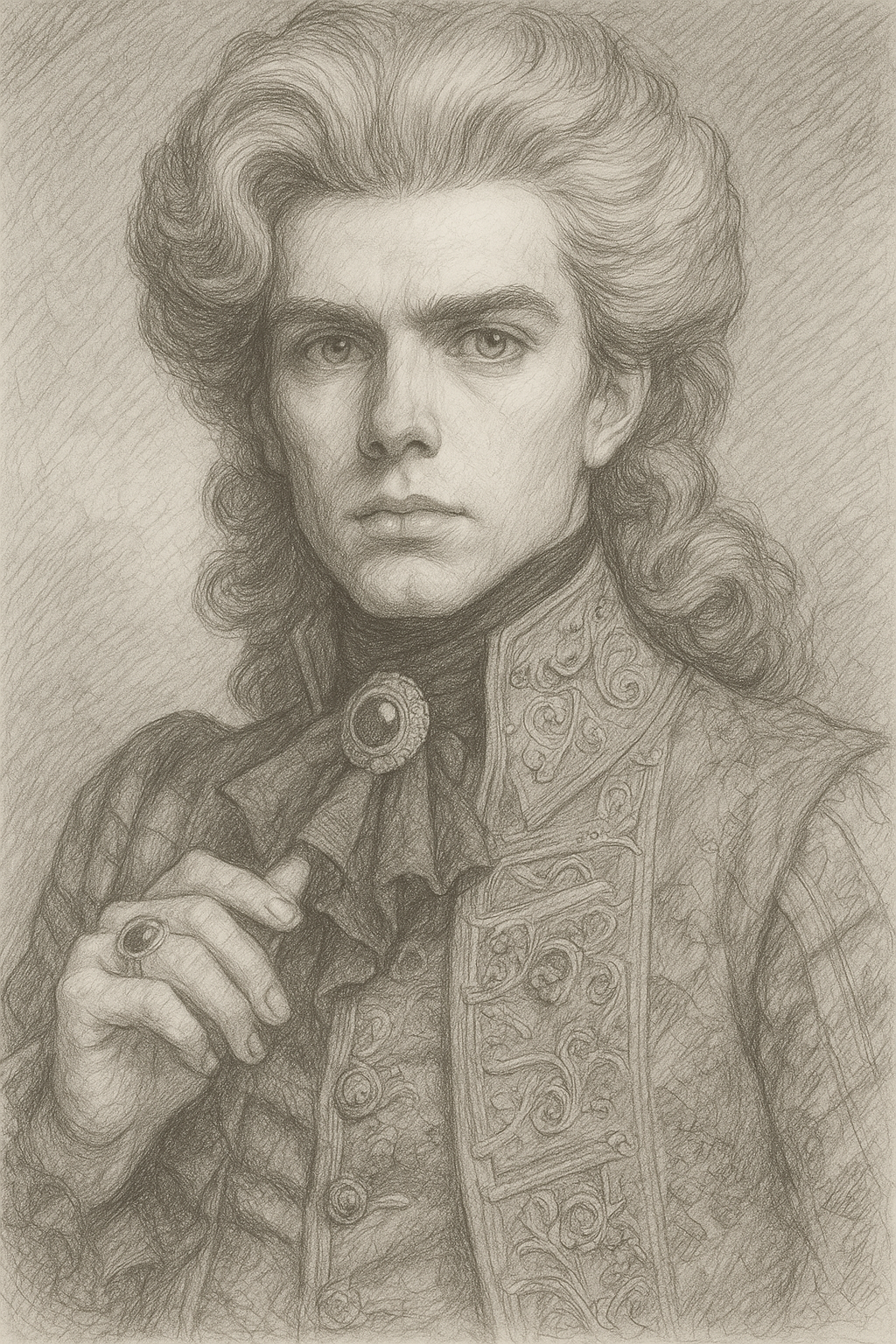
Ignatius "Ixnay" Krisholm
Beginnings
Ignatius Krisholm was born into a family which valued one thing above all else—ambition.
Oswald Krisholm, a ruthless and shrew merchant, had clawed his way up from modest trade contracts to ruling Nymerian trading routes in the space of a few decades. By the time Ignatius was born, the family manor stood tall and ostentatious. Its rooms were furnished with gaudy pieces and its vast library was stocked more to impress than to entertain.
In his father's mind, few things were as important as making a fortune and basking in the envy of others.
A Frail Youth
From infancy, Ignatius was frequently sick—his lungs weak, his joints aching, his body unwilling to obey his whims. He spent many long months bedridden, watching sunlight creep across the ceiling while physicians murmured reassurances they did not believe. Where others took pity, Oswald saw only disappointment; a son unfit to inherit the family name, let alone his mercantile empire.
With little else to occupy his time, the precocious boy found comfort in reading. By the age of six, Ignatius could read fluently. By ten, he was devouring history, philosophy, epic myths and obscure cosmologies with equal hunger. The written word became his sanctuary, a place where strength came from knowledge rather than brawn.
Family Bonds
Oswald had little affection for his son but same could not be said of Ignatius' elder sister, Prudence.
Sharp-witted, warm and quietly defiant, she became her brother's protector and only true friend. She smuggled books to his bedside, read aloud when his voice failed and offered kind words when their father raged through the halls.
One winter evening, when Ignatius was eleven and bedridden once more, Prudence gifted him a hand-carved dragonchess piece, its wooden features rough but lovingly shaped.
“This piece is known as the dragon,” she told him. “It reminded me of you because dragons don’t need to look strong. They are strong.”
A Broken Household
Oswald Krisholm was a traditional patriarch, demanding obedience and fealty from his children. Able-bodied as she was, Prudence refused to give him either.
Their clashes grew increasingly bitter, as Prudence refused arranged marriages and merchant politics, openly criticising her father’s selfishness and hollow ambition. The argument that finally broke the family was loud enough to echo throughout the manor—words flared, doors slammed and, by morning, she was gone.
Prudence's absence hit Ignatius hard. Now a young man, his health had improved but the loss left an undeniable void in his world. The manor felt larger, colder and haunted by silence. This, combined with his reclusive youth, made him an awkward, overly earnest man who was far too abrupt for polite society.
Once again, he was little more than a disappointment.
It was in this state of grief that he found the tome.
A Mysterious Patron
Investigating a sound he believed to be rats in the walls, Ignatius made a startling discovery. Hidden behind false shelves in the manor library was a dust-choked tome bound in cracked leather.
The instant he picked it up, the waking world crumbled away from his senses. Ignatius' mind flooded with visions; cities collapsing beneath imploding skies, continents warping like molten glass and, in the space between, a being gargantuan beyond comprehension, absorbing all into its amorphous mass.
From within his mind came a measured voice, speaking in fractured Common.
World ending. Hunger eternal. But hope remains. You can change it.
The voice did not demand. It did not threaten.
It offered a partnership... and power.
Power—not to rule or destroy—but to avert a cataclysm. Power beyond mortal reach, power enough to stand where others would inevitably break.
The Pact
Ignatius thought of Prudence, of the dragon, of the millions who would suffer if he refused the offer.
And so, as any hero from one of his books would, he accepted.
That very night, he packed what he could carry, slipped the dragonchess piece into his pocket and saddled his horse, Aquinas. He left no note for his father—no words could convey his feelings more powerfully than silence.
As the manor gates closed behind him, Ignatius looked only to the road ahead. Fragments of the vision swam through his mind, calcifying into a single ironclad resolution:
If the world is to end,
it will not go quietly—
for I will defend it until my last breath.

Comments