

Baltacanath
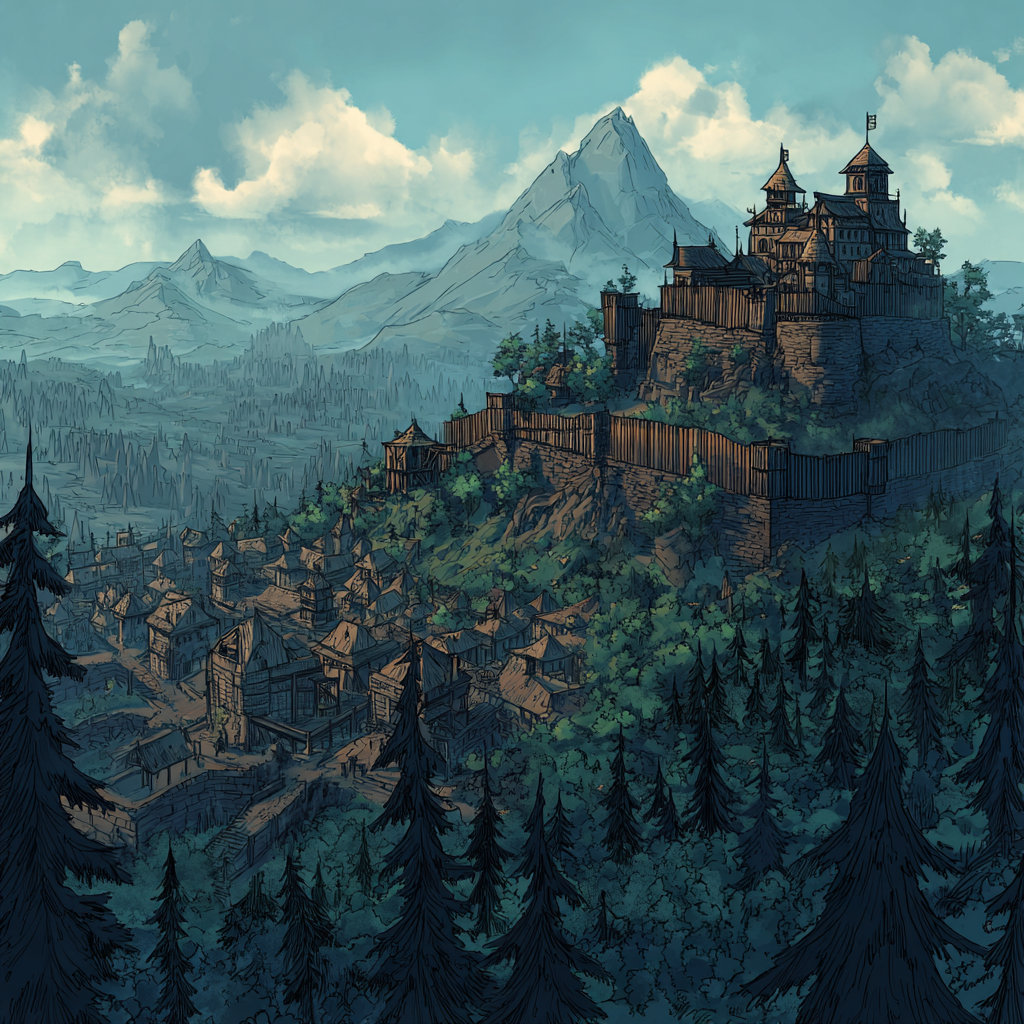
Small City: Population 5,986 (51% letheni, 15% vesperkin, 12% human, 10% lynoxi, 12% other)
History
Baltacanath is a former military outpost, a relic from the time of the Kingdom of Derunadel, after it was established during the Age of Creation to spy on the Drakantal Empire. The surrounding Landunethan forest provides thick cover that was used by the Letheni to hide from the patrols of the Drakantal Empire while they snuck into northern Arak to gather information about the Dwarves, as even then, the Dwarves were much more formidable than they were. When war broke out between the Kingdom of Derunadel and the Drakantal Empire, the information they gathered proved invaluable, and a stockade was built in the city to hold prisoners of war. As soldiers can get bored during long postings, a tradition formed where the Letheni would make the Dwarves fight each other to earn food, which was scarce; a tradition which has held to modern day, despite food no longer being as scarce. The city still serves as a garrison, though the soldiers there have rarely been needed since the formation of the Synodical Republic. After the destruction of the Drakantal Empire by the Voidspawn, Baltacanath gained access to more resources in the nearby Hestanfiaran mountains and the coast, expanding east during the Upheaval period to form the settlements of Landuwenian and Kor Silan. With no competing nation to the north, settlers began to flock to Baltacanath, preferring the isolated natural environment.
Once the garrison was no longer needed as a military outpost, the Kingdom of Derunadel converted the garrison into a training outpost for guards and soldiers, which it continues to do to this day, well after the Kingdom of Derunadel was dismantled. During the Upheaval period, as the city slowly began to take form around the garrison, settlers who preferred a less militaristic lifestyle or surroundings pushed eastward and formed the towns of Landuwenian and Kor Silan. While these towns have a relationship with Baltacanath, over time their cultures have diverged and despite falling under their jurisdiction, the two towns often want nothing to do with Baltacanath due to their controversial traditions and beliefs, isolating the town further. In recent years, others in the Tandavys'ian Tuathluwen region have called to put an end to Baltacanath's prisoner fights, but many of the locals in Baltacanath, as well as the Enforcers and leadership, stand by this tradition and defend it as justice.
During the Restoration period, when the Kingdom of Derunadel was dismantled and the Synodical Republic took power, the soldiers and Enforcers of Baltacanath did not take it well. Like several places across Arak, a civil war broke out in leadership and amongst the residents that saw hundreds killed in the fighting until forces from Mythwell were routed to quell the fighting. This civil war was due to clashes in loyalty and ideological values, and after the fighting ended it took years to stabilize the city. While there is no fighting in the streets as during these times, when the majority population is Letheni, many residents of the city were alive when these events took place and may have even taken part in the fighting, so the divide still remains. There is a clear separation between the majority Votrinian Letheni population and other residents who don't share their sometimes extreme conservative values. Some avoid traveling to the city specifically because there is a widespread belief that it is only a matter of time before the tension gives way to another conflict.
Government
The city is governed by Magistrate Sellenna Latherin, a Letheni woman who is nearly 2,000 years old, having lived in the city for all of her life. The magistrate also has jurisdiction over the towns of Landuwenian and Kor Silan to the east. She has served as magistrate for nearly 200 years and was previously a captain of the local Enforcers who led several defenses of the city against various threats, including defending the city against the undead legion that arose during The Long Night during the Reckoning period. Her long career has left her body in poor condition from old injuries, and she is confined to a wheelchair. She has a very black and white view of the world and is harsh on criminals, which she has faced criticism for; but continuing the tradition of allowing prisoner fights in the Dunior ith Landunethan has brought scorn from all across Arak.
Economy
Baltacanath does not attract many merchants, but being along a main road, it sees its fair share of travelers. Most of the city's revenue is generated through niche industries; abundant herbs cultivated in the forest and harvested, inns with unique cabins built on platforms over the Nolacarran, and of course the prisoner fights taking place in the prison. They also bring in a moderate amount of income by having the soldiers of the garrison train Enforcers from around the region. Much of the city's revenue funds maintaining infrastructure, including paying the Enforcers; other professions rely heavily on travelers and providing for the Enforcers to survive. As a result, many professions are not found here due to not being profitable enough, such as jewelers, clothiers, chefs, and librarians.
The city has access to some metals in the tip of the Great Divide to the west, as well as the Hestanfiaran to the north, but their most valuable resources are the herbs found in the Landunethan. The city has a number of herbalists and alchemists making use of these plants to make specialty medicines, and are paid well by the city to stockpile restorative potions for use by the Enforcers. There are two herbs that are the most important to the locals; Tikosin Serreneth and Dunarin Kefim. Tikosin Serreneth is a navy blue herb with many fronds forming a triangular shape which when ground into a paste can be applied to necrotized flesh or corpses to preserve the flesh, and even heal the necrotization to a limited degree; though further refinement is needed to truly heal this type of damage. Dunarin Kefim is a type of grass found in the forest which can be very hazardous, as it sticks straight up and is rigid. If stepped on, it can puncture straight through leather and into the foot. However, at night its rigidity fades and it can be easily gathered. When boiled for several days into a tea and combined with other healing herbs, it can create a potion that not only heals, but completely stops bleeding. However, it must be carefully strained to avoid leaving behind any tiny pieces of the grass, otherwise if ingested it could shred one's insides, leading to a painful death.
Notable Locations
- Narunthir ith Mauran'koni - This garrison constructed at the top of a large mound sits at the city center, the only portion of the city which is surrounded by walls; constructed of thick stone, and 20 ft. tall. The garrison houses some 1,000 soldiers, but many are packed in tightly in cots. The garrison sits on top of the Kulinthur ith Athissa stockade, with numerous access points throughout. At the center of the garrison is a large lookout tower for watching for anyone approaching on the road.
- Kulinthur ith Athissa - This large stockade sits underneath the Narunthir ith Mauran'koni on the hilltop in the city center. Once housing prisoners of war, it is now home to conventional prisoners. There are prisoners from all around the Tandavys'ian Tuathluwen who are sent here to serve their sentence. It is well known in the city that the stockade contains an "arena" built during the Age of Creation where Dwarven prisoners of war were pitted against each other to earn food. In modern times, citizens are brought here to watch fights between prisoners; not for food, but to generate money for the city. Prisoners that choose to fight can reduce their sentences; a practice which has been widely criticized.
- Dunior ith Landunethan - The infamous arena located within Kulinthur ith Athissa lies within the center of the prison's many cells, and is circular and only about 80 feet in diameter. The fights here are not meant to be to the death, but it does happen. There are a number of elevated platforms, pillars, and obstacles to make things more interesting for the spectators, who sit 20 ft. above the arena on stone benches. The spectator's area has passages leading to the city outside, which are heavily guarded. Even so, there have been several prisoners who have managed to scale the walls and escape through the tunnels throughout the city's history; events which have made them legendary among the other prisoners.
- Nolacarran - This lake to the southeast of the city is a popular destination for the city's residents, as its naturally warm waters are a popular bathing area and place for relaxation. The waters flow down from a tarn in the Hestanfiaran mountains to the north, which is heated by a natural hot spring deep within the Deephollow. The heat from the water causes a fog to form over the lake on chill days. It is not unheard of for people to go missing while bathing in this dense fog, though it is unknown whether this is due to a predator in the Landunethan forest, or something more mystical.
Culture
Though the city isn't too far from others that see a lot of travel, Baltacanath is "out of the way", and doesn't see a lot of incoming merchants itself. The Letheni that live here rarely speak Myrian, only speaking their native tongue in thick accents, so there can be a language barrier for some who find themselves in the city. However, there are plenty of Vesperkin offering translation services. Because it does not see many merchants, goods and services in the city are limited, as is their food and culture. As a result, the culture in the city is predominantly Letheni, with few traditions of other cultures publicly observed. Most Letheni in residence are Votrinian, so the city has a very conservative culture, shunning many Human holidays; especially the ones involving nudity.
With a long history of military culture prominent in the city, it is no surprise that many of the locals' customs are militaristic. The magistrate has fostered a sense of loyalty among citizens for the city's Enforcers, with many growing up to view them as heroes and praising them despite their many obvious faults. There is a holiday called Reka ith Am Narunthir observed at the end of each month during which exceptional Enforcers are publicly awarded commendations for their deeds, and then allowed to dine with the magistrate for dinner. Additionally, citizens will work together to scour, clean, and polish the Enforcers' armor and clean and hone their weapons. It is expected of all citizens to know how to perform these services. It is also part of each child's education that they must learn to wield a weapon so that a militia can be formed in the event the Enforcers are outnumbered, incapacitated, or otherwise.
With sparse merchant traffic, the variety of foods available to residents is fairly low, so locals have had to get creative with the ingredients they have available. However, limitations breed innovation, and there are a number of dishes that have emerged from these simple ingredients that even travelers coming from places with far more culinary variety have praised for their flavor. One such dish, called Acarun Mandurrel, is a sandwich that is popular with soldiers and Enforcers that is made with a delicate buttery bread with a medley of seasonal vegetables that have been smoked and cooked down, along with a locally made cheese melted over the top, all topped with a local honey. Another local favorite is Sardussim Kasuvemir, a skewer of vegetables and sometimes meat that is cooked over a fire that has wet wood placed on top to smoke the skewer as it cooks, after which the entire skewer is coated in a batter containing alcohol that is fried, and finally topped with a garlic sauce.
Defenses
Despite being an ancient military outpost, the only walls the city has for defenses are constructed around the Narunthir ith Maruan'koni, as it needed to be defended against attack. The surrounding city structures are open, though not completely defenseless. The city garrison supplements the local Enforcers, standing guard on the outskirts of the city to watch for Goblin attacks or other threats. Due to how isolated the city is, Goblin attacks are fairly commonplace. As a result, many must hire soldiers to protect them on the road on their way towards the main road towards other places like Mythwell. The chapter of the Emerald Company in residence in the city has deployed a clever tactic of constructing scarecrow-like structures around the city along the roads to the give the Goblins the impression that the roads are better defended than they are, as the Goblins nearby are of the yellow variety; vicious, but stupid. This has helped to keep them away outside of the forest, but in the forest, they are much more devious, employing traps.
Crime
With so many Enforcers present and a military culture, crime is punished harshly in Baltacanath. It is widely known that prisoners are forced to fight in the Dunior ith Landunethan beneath the garrison, a spectacle which is opened to the public for profit. This is the most controversial tradition in Baltacanath, one which its residents show no sign of caring to put an end to, especially when it's so profitable. Despite widespread criticism of the tradition, travelers passing through here frequently come to watch the fights, with some traveling to the city specifically just to see them. Given its importance to the economy, this has bred corruption among the Enforcers, who manufacture reasons to arrest people in order to keep the prisons full. If Magistrate Sellenna is aware of this, she doesn't seem bothered by it.
Magistrate Sellenna, having served as a captain of the Enforcers herself, has a very absolute idea of justice, and overlooks nuance in favor of the letter of the law. Murder is punished by execution; but rather than hanging them like some other magistrates do, they are put unarmed into the Dunior ith Landunethan surrounded by Enforcers wielding cudgels, who beat them to death in front of the crowd. Murders are rarely investigated properly, and several serial killers have managed to escape justice for far longer than they should have as a result, with innocents being executed in their place. There are a handful of free agents operating in the city who attempt to stall executions and investigate murders themselves in order to reduce the number of innocents who are executed. The magistrate justifies this by claiming that by delaying justice, it is denying justice; saying that extensive investigations invite bribes and allow criminals to escape. She also asserts that fear is the best preventative measure against crime, though the fact that crime still exists complicates that claim. She believes that her absolute justice protects against bias. Besides murder, most crimes will land you in prison for varying lengths of time.

Comments