
Gods & Religions of Aelas
There are many different religions and systems of belief throughout the land of Aelas. The vast majority of its inhabitants believe in the gods of the High Pantheon: a polytheistic faith of 13 deities (sometimes more sometimes less depending on the culture). Outside of this, the other smaller religions of Aelas make up a diverse range of polytheistic pantheons, monotheism, cults, monolatrism, shamanism, and broader forms of spirituality.
Miracles and wielders of holy magic have been documented from several of these faiths, but the number of contradictory beliefs, and the lack of any tangible proof of the gods' existence outside of their priests' powers makes the truth of their divinity and the existence of any gods uncertain.
While priests, clerics, and paladins are able to call upon the powers of their gods, Aelas is also home to skeptics, believers of competing faiths, and even atheists who believe the source of these powers is real but not divine. That being said, the majority of people are religious or have some sort of belief in the divine.
The High Pantheon
The High Pantheon is the most widely practiced religion on the continent of Aelas, and one of its most ancient. Individual adherents of this faith typically honor all of the hallowed gods while significantly favoring one in worship.
It is a polytheistic faith that is worshipped by all manner of peoples regardless of class, race, nationality, or even region. However, the religion changes shape across different cultures, as some will omit gods, others will include local deities and superstitions, and certain gods are reviled altogether depending on where in the world one finds themselves.
These 13 deities are split between two groups: The Hallowed and the Unhallowed.
The Hallowed Gods, are broadly considered to be those who uplift, defend, and bless mortal kind while upholding righteous values and safeguarding the natural order. These gods are the most commonly worshipped and honored. Their shrines, temples, and priests can be found across all Aelas and one need not look far to find one.
The Unhallowed Gods, are deities of a less savory aspect; ranging from morally gray spirits to purely malevolent demon kings. Temples to an Unhallowed god are prone to vandalism and grafitti from the many who disdain their worship as profane, unholy, or abjectly evil.
Hallowed Gods
It is held by worshippers of the High Pantheon that the Hallowed Gods are united in fellowship, working together to maintain the natural order and answer the prayers of the righteous.
Ilarom, Goddess of Light
Ilarom is the most worshipped of all deities in the High Pantheon, and the most powerful. Ilarom is unyielding. She is a warrior for justice and is the champion knight of the gods. The light of Ilarom is an unceasing force bringing clarity and warmth to those who are lost, but a burning weapon against the wicked and their machinations. To Ilarom, the world is comprised of either purely good or purely evil. Shades of gray are illusions. There is only light and dark. While her adherents are meant to strive for goodness in all aspects of their lives, the intensity of her faith inspires violent extremists and religious zealots.
Domains: Light, The Stars, Justice, Strength, Morality, Purity, Chivalry, Cedar Trees
Symbol: Constellation of Seven Stars, Cedar Tree
Afterlife: Ascension
Liturgical Language: Celestial
Paladin Orders: Holy Order of Cedar, Holy Order of the Seven Stars, Holy Order of the Blue Blade, Holy Order of the Burning Ray
Azkarom, Goddess of Mercy
Azkarom is associated with gentleness and mercy. She is the goddess one turns to for sanctuary, absolution, and kindness both for oneself and for others. More than any deity, Azkarom embodies the values of charity, nonviolence, and personal sacrifice.
Domains: Life, Healing, Mercy, Sacrifice, The Hearth, Rain, Family, Foxfire
Symbol: Green Flame, Raindrop
Afterlife: Ascension
Liturgical Language: Celestial
Paladin Orders: No Organized Paladin Order
Kazoreh, Goddess of War
Kazoreh represents the might of civilization and the glory of battle. Her right hand is trade, law, construction, and craft. Her left hand is the strength and struggle it takes to defend those values. While she is the goddess of war, she is just, and takes little pleasure in the waging of it. She is often worshipped by soldiers, judges, tradesmen, artisans, builders, and merchants.
Domains: War, Civilization, Valor, The Sun, Steel, Trade, Law, Crafting, Artisans, Society, Order
Symbol: Hammer or Shield Within A Sun
Afterlife: The Cities of Gold
Liturgical Language: Celestial
Paladin Orders: Sacred Order of the Iron Lion, Sacred Order of the Weeping Sun
Lunoreh, Goddess of Wisdom
Lunoreh is a quiet force in the universe, seeking to reward rather than punish. If her followers do her wrong, she withholds blessings rather than inflicting harm. When she is pleased, she guides her flock with a gentle push. Omniscient and secretive, she preserves, blesses, and protects truth and wisdom across the cosmos from those forces that seek to blot it out.
Domains: Knowledge, Wisdom, The Moon, Science, Writing, Poetry, Secrets, Alchemy
Symbol: Crescent Moon With An Eye filling the gap, Luna Moth
Afterlife: The Cities of Gold
Liturgical Language: Celestial
Paladin Orders: Sacred Order of Saint Origath ((dragonslayer)) (Presumed Disbanded)
Manaria, God of Storms
Manaria is seen by his followers as a force of nature, like any hurricane or whirlwind he creates. He is a passionate god who is quick to anger but rewards piety with earthly bounties like prosperous harvests, excellent fishing, and kind weather. Manaria does not judge the sins of individual folk, but nations and communities as a whole. Worship of this god is as ancient as the sea and awesome as its wrath. Worship of Manaria is ubiquitous, and second in popularity to Ilarom.
More than any other god of the High Pantheon, Manaria's depictions, description, lore, and personality differ depending on the culture worshiping him.
Domains: Tempest, The Sea, Land, The Sky, Fire, Mountains, Water, Wind. Stone
Symbol: A Hand Emerging From a Vortex, An Eight Winged Serpent, Pentagram
Afterlife: The Vale of Summer
Liturgical Language: Celestial, Primordial, Common
Paladin Orders: Blessed Order of the Forking Flame, Blessed Order of Eight Wings
Suniria, Goddess of The Wilds
Suniria is the deer you caught today and the bear that catches you tomorrow. She is the venom you suffer when you venture too far into the woods, and she is the healing power of the herbs that neutralize it. She is the master of all things living and wild: from a blade of grass to gargantuan beasts. She represents the unwritten laws of the wilds, the thrill of the hunt, the primordial majesty of life, and the balance of nature. Concepts like good and evil are weighed by this god in an environmental framework rather than a civil one.
Domains: Nature, Wild Animals, The Hunt, Forests, Herbs, Plants, Primal Urges
Symbol: Deer Head With Antlers And A Crown of Holly
Afterlife: The Vale of Summer
Liturgical Language: Sylvan, Elvish, Druid
Paladin Orders: No Organized Paladin Order
V'shesh, God of Death
V’shesh is the least revered of the hallowed gods. Institutions devoted to him are rarer than nearly every deity of the High Pantheon, including the Unhallowed. V'shesh is often depicted as a grim reaper, skeleton, or an old and sickly man wrapped in rags. V'shesh does not give blessings, he rarely intercedes in mortal affairs, and those seldom few who worship him don't expect him to grant them favors. He is as cold, unfeeling, and dispassionate as the grave. While hallowed, for he is a controversial god to worship. Those who praise him search for meaning in death, or for peace on their journey to the end.
Domains: Death, Night, Silence, Winter, Darkness, Sleep, Peace, the void, Endings
Symbol: The Rune of Endings (Three concentric black circles enclosing each other), Skull
Afterlife: None
Liturgical Language: Celestial
Paladin Orders: Godly Order of the Silent Tower (Presumed Disbanded)
Unhallowed Gods
Unlike the Hallowed Gods, there is no fellowship among the Unhallowed. They pursue individualistic or selfish ends, often clashing with each other in their questionable ambitions. However despite their motley nature, the worshippers of these deities are no less moral than their Hallowed-worshipping peers as a rule of thumb. Shrines, priests, and temples of these gods are far less common to find than those devoted to Hallowed gods.
Some of the unhallowed gods are considered sacred and benevolent in a minority of cultures, while being disdained by the majority as tricksters, blasphemers, or worse.
Zatserah, God of Thieves
Depicted as everything from a raucous yet divine fool to a demonic prince of wickedness, worship of Zatserah is widely misunderstood as a justification of hedonism and crime. Zatserah worshippers are few and far between, but regardless of what path they take in life, they find comfort knowing that their deity readily accepts those whom the world tosses aside. Though Zatserah is a god of the wretched and larcenous, some hold him to be the most forgiving of the pantheon, for no blackguard, thief, or wretch is beyond his blessing.
Domains: Trickery, thieves, luck, shadows, poetry, secrets, theatre, orphans, outcasts, and travelers.
Symbol: N/A
Afterlife: The Crossroads
Liturgical Language: Infernal
Paladin Orders: No Organized Paladin Order
Leyentran, Goddess of Love
Priests of the Hallowed gods would tell you that Leyentran is better off appeased than revered. More than all other deities, she craves praise and supplication, but do what you can to stay out of her attention. Leyentran takes great pleasure in meddling with the affairs of mortals. The world is littered with tales of her taking the form of beautiful men, women, and everything in between to seduce whomever catcher her eye that week. She is the master of all things beautiful, the crest of all passions, and the herald of metamorphosis whether speaking of shapeshifters or the beginning of new eras. Her devotees believe she could exist anywhere in the world, taking the guise of anyone. In her true form, she is an androgynous elven woman of unworldly beauty, and an archfey of tremendous power. She is the supremely worshipped deity to nearly all creatures of fey aspect or a bear connection to the Sundown Lands.
Domains: Romantic Love, Trickery, Beauty, Lust, Illusion, Passion, Flowers, Transformations, Espionage, Twilight, Revenge
Symbol: Three Roses Emerging From A Single Stem
Afterlife: N/A
Liturgical Language: Sylvan
Paladin Orders: No Organized Paladin Order
Jahurai, God of Fire
In the lore of the High Pantheon, Jahurai is a demon king who despises and envies Ilarom, corrupting her most pious followers and spreading fire and death wherever he pleases. On the tropical island of Kestu, however, he is worshipped as their most sacred deity. Most of his worshippers are Kestunese (mainly Tieflings) who revere the flame he gave to mortals when they were young upon the earth, the volcanoes he enriches the soil with for crops, and the ardor he instills in the driven. His followers do not love the flame for what it burns, but for how much it can accomplish, and view him as a righteous god. He is said to have taken a flame archon for a wife. Other than the brief Leyentran tryst, Jahurai is the only married god of the High Pantheon. Most hate the demon king, but there is great love for him in the southern jungles of Velda, beyond the reaches of Aelas.
Domains: Fire, Ambition, Destruction, Revenge, Invention, Volcanoes, Lava, Gold, Gemstones, Passion, Wealth, Tigers
Symbol: Crown Engulfed In Flame, Tiger Paw
Afterlife: Mount of Brimstone
Liturgical Language: Infernal
Paladin Orders: No Organized Paladin Order
Ganhurai, God of Bloodshed
Ganhurai is considered to be one of the weaker gods, as his many battles with the Hallowed gods left him scarred and weakened from his once eminent form. Despite this, he is one of the most frightening gods of any faith. Ganhurai is a demon king whose ambitions lie entirely on the perversion of anything protected by the Hallowed gods. He delights in inflicting pain and spilling blood, and is worshipped by the practice of ritual murder and flagellation. He is the most sinister and malevolent of the High Pantheon, and there is no accepted practice of this god in any culture of Aelas. All who praise the god of bloodshed do so in secret, meeting with cults and covens to do his dark bidding.
Domains: Bloodshed, Pain, Conquest, Murder, Torture, Blasphemy, Ruin
Symbol: N/A
Afterlife: Red Abyss
Liturgical Language: Abyssal
Paladin Orders: No Organized Paladin Order
The Reveler, God of Wine
The Reveler, whose true name is a secret known only to the most devoted of his cultists, is a fairly minor deity. Much of the world sees him as a wayward god, hedonistically indulging in wine and debauchery. Little more than a bad influence, commoners see him as the ever-drunk punchline of the High Pantheon. Those wise in theology, however, know him as an enemy of the Hallowed gods. The Reveler is sometimes written of as a demon king, and the source of all madness. He is a tempter who leads mortals into insanity, ecstasy, and sometimes infernal power. While most Reveler cultists aren't evil, they're rarely upright citizens. The cult encourages the stoking of one’s primal impulses and the stroking of one’s innate hedonism. Moderation, temperance, and even charity are all but absent in his teachings. Worship of the Reveler used to be popular millennia ago, but it has long since shriveled to only a handful of temples. He is worshipped by satyrs to a disproportionately high degree. Many satyrs believe they are direct descents of this god of the vine.
Domains: Wine, Revelry, Pleasure, Vines, Drunkenness, Music, Madness, Forbidden Knowledge, Hedonism, Chaos, Fennel
Symbol: Goblet With A Grin
Afterlife: The Orchard of Night
Liturgical Language: Abyssal
Paladin Orders: No Organized Paladin Order
Yorentran, God of Pestilence
Yorentran is the only god who shuns his supplicants and hates his own worship. Legend has it, he despised mortals so much that he brought all manner of disgusting and unpleasant things under his influence, so no person would ever want to utter his name in prayer. Yorentran is depicted as a curmudgeonly and cantankerous man, and is considered to be an archfey of godly power. What few clerics attempt to enshrine institutions around his worship have all been met with infamously terrible fortunes and gruesome ends. As such worship of him is seen as deeply unlucky and foolish. He is sometimes called the lonely god, and is believed to live somewhere in Aelas as a hermit, wanting never to be bothered with anything outside of the walls of his hidden cottage.
Domains: Disease, Rot, Vermin, Mushrooms, Parasites, Loneliness, Bitterness, Onions, Hermits, Garlic, Sulfur, Stinky Things
Symbol: Black Garlic Bulb
Afterlife: N/A
Liturgical Language: Sylvan & Druid
Paladin Orders: No Organized Paladin Order
Meledism
Meledism is a monotheistic faith centering around the belief and worship of the benevolent creator god Meled. In the beginning of time, Meled used music to create the universe, and sustains it by continuing to play what is referred to by his supplicants simply as, The Song. It is a melody of infinite power which is the fabric of all things, and communing with its hidden sound in the background of the universe imbues one with blessings, power, and nourishes the soul. One day, Meled will stop playing and the universe will simply end. When everything is over, it is up to his followers, the Meledites to begin The Song again, and tell the tale of all things.
Meled's believers are all musicians, storytellers, bards, and actors (but mostly musicians). They believe they must wander the world spreading joy and music, and doing as much good as they are able for the sake of "sweetening The Song,". They believe one good actions reverberates throughout The Song, changing the universe even if a little, in the direction of justice. Meledites show their faith by wearing small jingling chains, bells, or chimes from their garments so they are always making music in their day-to-day life, to live up to the example Meled has set. These are worn on them at all times, and must never be removed willfully, as part of a solemn oath. They are pacifists, but will resort to using violence if only to save a life. Meledites live under a strict orthopraxical code of conduct so as to live a life that will sweeten The Song, and repair the wickedness of the world. Many bardic traditions came from this faith. The origins of this faith are enigmatic and shrouded in secrecy, but have their roots in the (now fallen) empire of Adravas.
Orcish Religions
Firewind Tribe
Orcs of the Firewind Tribe don't concern themselves one way or another with divine beings. Their spirituality focuses on their ancestors and what lies in the material world, especially the exploration and discovery of the world's outermost limits. Their religious practice centers around the gathering of a legendary and extremely rare substance called the aether. It is a luminous plasmoid material that they believe borders the edges of the known world. The Firewind believe the world to be a flat disc surrounded on all sides by this holy substance. Their greatest clerics are explorers who have adventured to the edges of existence to claim a fragment of it. Firewind believe the aether must be united from the edges of the east, west, north, south, above, and below. On their sacred mountain, there is a lamp containing two of the six. Once all six pieces of aether are set in the lamp, the light that it shines will herald a messianic age of bliss and plenty.
Fargaze Tribe
The Fargaze are an animist tribe, recognizing the existence of spirits that dwell in nature, far planes, handmade items, and the afterlife. Central to the exaltation and reverence of their faithful is the worship of Tarquin, the great spirit of the river Tar'Kwen. The land of the Far Grasses, and especially the Tar’Kwen river are central to this faith, as the orcs hold the river to be extremely sacred. Intermarriage with humans is a highly discouraged by this faith. The Orcs believe in the healing and purifying power of the river, and have been tasked by the spirits of the land with protecting the Far Grasses from pollution, overfishing, and overdevelopment from the human tribes and the empire of Liothe. They believe the river is what granted this tribe its sorcerous affinity for divination.
Shatterblood Tribe
The Shatterblood are not a united tribe, but a collection of warring and rival clans united by region and culture alone. They have no uniting religious doctrine, but each of the four clans is zealously devoted to their own patron god. These four religions are the main schism and the main badge of identity within the Shatterblood Clans.
Whitearrow Tribe
The Whitearrow orcs venerate their ancestors' spirits above all else. Their faith is not well defined, and there is no doctrine, orthodoxy, nor any laity. Each family performs shamanistic rituals and ceremonies concerning the veneration and worship of their forebears' souls.
Church of Varai
Among the newest religions in Aelas is this quickly spreading monolatry, venerating Varai, god of magic and glory. This figure was extremely obscure just a few winters past, mentioned only a handful of times in deeply ancient Dwarven carvings and elven songs with details which are vague at best. Believers revere Varai as a supreme being, dwarfing other gods as lesser spirits. He is seen as a merciful warrior-poet who brought light into the world, introduced magic to mortals, and drove a foul race of monsters from Aelas, so that mortals could possess the earth. He is a generous god, who blesses his believers with intelligence and power, rather than grace and good fortune. Those who are initiated into his flock are gifted a unique amulet by the clergy. This amulet gives its wearer the ability to perform numerous cantrips and spells at will, regardless of any training in the arcane. This reason is why his popularity is exploding across southern Aelas from Liothe to the Gulf of Sirens, despite this religion being less than a decade old. He is often depicted as a tall Human or Elf wielding a sword and a book in either hand. Sadly this faith has put many rural smallmages out of business, as commoners need the services of a local wizard less and less.
Domains: Magic, Intellect, Power, Glory, Light, Discovery
Symbol: Eye Within A Pointy Heptagon
Afterlife: Ild
Liturgical Language: None
Paladin Orders: No Organized Paladin Order
Sea of Night
The Faith of the Human Razih Tribe is entirely unique from the other nations of Aelas. The Razih reject the existence of the gods of any faith. They either disbelieve in the existence of gods entirely, or believe them to exist as beings of great power, but not divine. Rather than supernal beings, adherents of this faith worship and honor the spirits of their ancestors, using tribal necromancy to directly draw upon their power and wisdom from beyond the grave.
The afterlife of this faith, is the center of all Razih theology, and is called The Sea of Night. In the Razih tongue, Mamur’Alul. the Sea of Night is believed to be a realm of pure darkness and quiet, that touches all the realms of the cosmos with an undulant push and pull, like waves lapping upon a shore. They send prayers, exaltations, and even sacrifices into the Sea of Night. Their clerics are empowered by the ghosts of their ancestors and the lore of the Sea of Night, making their priests and their necromancers one and the same.
Cult of Voshek
Halfmoon is ruled over by a dark sorcerer king, known to his worshipper-subjects as Highlord Voshek. To those outside this dark kingdom, Voshek is a mystery, but those living under him are required to worship him as their supreme god-king. It is Halfmoon's state religion and a literal cult of personality. Voshek worshippers outside of Halmoon are completely unheard of, save for the rare royal emissary able to cross its borders. Most adherents of this faith actively don’t want to worship Voshek, but feel their life would be in danger if they didn’t. What little intelligence leaves the borders of the reclusive nation, speak of him appearing as a handsome yet malformed elf. He looks unlike any elf in Aelas, and has reigned as Halfmoon's only king in history since its independence hundreds of years ago. Voshek has a proclivity for blood magic, necromancy, and the darkest aspects of the arcane. As such he considers himself a patron to all in his kingdom who wish to risk exploring the malevolent secrets of forbidden magic.
The Wisdom Eternal
The Wisdom Eternal is an immortal entity of near-omniscience and worshipped by the High Elves of Arthia as their divine protector and sovereign. There is no being like it now, nor in the past. Its origins are shrouded in mystery, unknown even to those who revere and worship it. Legend states that it has existed since before Arthia, and came to reign there during the Age of Heroes. Its power is said to rival that of deities, surpassing anything terrestrial or mortal in the land of Aelas.
Arthian lore holds that it dwells within a gargantuan white stone compound in the center of Arthia called The Celestial City. The Celestial City is completely sealed off from all entry, and it is forbidden for anyone to set foot within on pain of death. Only those rare few each elven generation who have been chosen by the Wisdom Eternal itself, are permitted to enter, and those who do never leave. Though there have never been any witnesses to confirm this, it rewards its chosen few with immortality, wisdom, and tranquility provided they never leave the Celestial City again.
No one in Arthia, outside the Celestial City, has ever seen The Wisdom Eternal since the age of heroes over 5000 years ago. If the legends are true, it may be the only surviving entity from that bygone era of myth.
Cult of Sugoshir
The snake god Sugoshir is an ancient deity whose veneration predates most of the world’s nations. His worship has steeply declined in the last two thousand years. Only one city still reveres this ancient desert god, the way many kingdoms once did.
The city-state of Surush holds Sugoshir as their patron deity, and includes him as an eighth Hallowed god of the High Pantheon. He is a snake that rivals the size of mountains who lives deep beneath the earth or in the world of dreams. Once his worship was central to the great empire of Sytheshir, but after it fell, so did his popularity. Those few Yuan-Ti left in Aelas consider Sugoshir to be their direct ancestor. While this cult is now a shadow of its former self, reverence of all seprentlike folk lives on in its followers who idolizeLamias, Gorgons (Medusas), Nagas, and Snake Shifters as connected to Sugoshir's divinity. Sugoshir worshipers regard snakes as holy creatures and forbid eating or harming them in any way.
Domains: Victory, night, assassins, secrets, war, sleep, the desert, stone, venom.
Symbol: Two Snakes Originating From The Same Midsection, In
Afterlife: Dreamer's Labyrinth
Liturgical Language: None
Paladin Orders: No Organized Paladin Order
Dragon Ghost Religion
Two thousand years ago, when the empire of Adravas was at the height of its power, millions of people worshipped the ghosts of dragons, whose essence made up the very earth of the Dragonbone Desert. Hundreds of dragons long passed, whose spirits clung to the most distant of the Seven Sands, were invoked by dragon priests of Adravas who called on them for wisdom and power. Chiefest among them were the three dead dragon kings of eons past, Aras-Kham (Red Dragon Spirit), Kova-Kara (Blue Dragon Spirit), and Tai-Shahass (Black Dragon Spirit). However, now, six centuries after the empire's fall, the institution of this religion has all but vanished from the world. Only a few hundred adherents of this ancient religion are what survives. With the ruins of Adravas and the silver dunes of the Dragonbone Desert completely cut off from the rest of Aelas, the dragon spirits can no longer be summoned. However, this doesn't stop the few believers left from their long-practiced festivals, holidays, and prayers to the old dead dragon deities. This religion is practiced only by a few Adravasi descendants of the Mamejah Tribe and a large portion of the rare dragonborn race.
The Shepherd in the Storm
In the Far Grasses, worship of an ancient tribal god is kept alive by remote Liothan villages, wayward Fargaze orcs, superstitious sailors, and every centaur tribe under the sun. The Shepherd in the Storm is a minor deity, said to inhabit great banks of fog and vicious thunderstorms that pass over the Far Grasses. He also presides the shallows of the Mestran Sea that border the grasslands. Those who have seen him describe the silhouette of a stag-horned centaur peeking out through curtains of rain or cloud. He stands as high as the sky, dwarfing the mountains, and wielding a great spear in his hand. He never fails to turn his gaze toward his witnesses, no matter how tiny or remote, and then he vanishes quietly into the obscuring weather. Many, not just his worshippers, in the Far Grasses have claimed to witness him.
The centaurs believe he is one of thousands of gods, but the only true deity of his ilk to ascend to Aelas from the infinite depths of the Mestran Sea. He favors those who praise him, but above all else, those who sacrifice to him. The mightier the warrior and the more important the figure, are the most pleasing of sacrifices. Centaur tribes have been known to kidnap champion knights of Liothe and Small Harbor, and bring them to an altar in the ruins of Jastell to sacrifice to this god. When one dies, their soul enters the depths of the Mestran Sea, which they believe is not just a body of water. Worshippers see the Mestran as a liminal realm between all planes of existence, where gods are born and souls enter when they die.
It is considered strange, heretical, and even alarming in most cultures for a non-centaur to be a devotee to this violent god.
Domains: Centaurs, Horses, Storms, Speed, Battle, Chaos, The Tides, Grass, the Far Grasses
Symbol: Horse Head Silhouette With Uneven Stag Horns
Afterlife: Depths of the Mestran Sea
Liturgical Language: None
Paladin Orders: No Organized Paladin Order
Orsulas, God of Flesh
Deep beneath the surface of Aelas, the shadowy Underdark stretches on for untold fathoms and leagues into the cities of nameless things and the realms of horrors that would fill even the Songborn with terror. The lands of the underdark, though hateful toward each other and disparate, are united in respect for Orsulas, God of Flesh.
Orsulas is a primordial being spoken of in the earliest ever tales of the Underdark that survive to this day. Those who worship him, see Orsulas as the sovereign lord of all bodies. He is the progenitor of bone, the weaver of skin, the author of blood, and as old as the world itself. Those who follow the creed see Orsulas as an inseparable part of Aelas, as intertwined with the world as the most ancient spirits of forest and ocean. Whether a supplicant or an infidel to the flesh god, Orsulas is feared and respected by every nation of the underdark. No individual in the chthonic world under Aelas would ever deny his existence, regardless of their own faith or creed. This is because Orsulas doesn't dwell in a heaven nor another realm, but a fixed place in the Underdark. To those wise in the ways of the subterranean realms, the road to the flesh god's lair is known, and if one has the courage and a good enough reason to entreat with a god, he will grant you an audience. In addition to flesh and bone, Orsulas is a god of deals and covenants. He is quick to strike up a faustian contract between himself and anyone intrepid enough to enter his gore-woven lair, The Seat of Hunger. From the vein-carpeted halls of the Seat of Hunger, those brave or foolhardy enough will bind themselves in service to the blood god. Like all flesh, Orsulas is servant to his own wants and appetites. If you seek a blessing from the god directly, he will likely send you first to retrieve what he desires. Fail to, and you become a target for his army of paladins, the Blessed Order of the Veinbrood.
Domains: Flesh, Blood, Bone, Life, Skin, Vampirism, Ambition, Covenants, Intellect, Pain, Pleasure, Birth
Symbol: Eyes And Mouth Within A Red Hand
Afterlife: N/A
Liturgical Language: Primordial
Paladin Orders: Blessed Order of the Veinbrood
Atheism
There are atheists who don't believe in the inherent divinity of holy magic, while recognizing it comes from a great power, that they believe is either a part of the material world or just poorly understood. However, certainly not a god. What have the gods done for them? Has Ilarom proven her existence beyond the glowing hands of a sanctimonious elder? Is a wizard less special for their fireball, than a Jahurai priest is for theirs? Not everyone believes in the gods, and that's okay.
You won’t be shunned or labeled a heretic, but some people might think you’re a bit of an oddball or perhaps no the brightest flame in the candelabra. Lack of belief isn't a threat to Aelas' various clergies when compared to demon worship and magic snake cults, but it isn't a popular opinion in most cultures.
You won't find people waving Richard Dawkins books around the gloomy tunnels of some dungeon, but that doesn't mean there aren't folks across Aelas who think people just aren't asking enough questions.
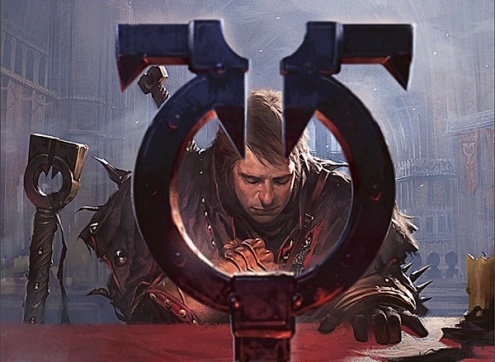
A paladin of Kazoreh, goddess of war and society, prays at an altar of the High Pantheon, adorned with an iron-forged symbol of the High Pantheon.
Article Contents
Comments