Evermore (COM; /ˈɛvəˈmɔː/, [EV-er-MOHr])
The Grim Reaper, True Death
Words
Evermore is the greater god of Death, Reaping, Souls, & the Afterlife, and is the one 'true death' on Aanrah. Everyone and everything that dies on Aanrah ultimately face Evermore in the end, and nobody escapes the reaper.
Nobody but one.
They are considered to be the sibling of Finseute.
Description
Appearance
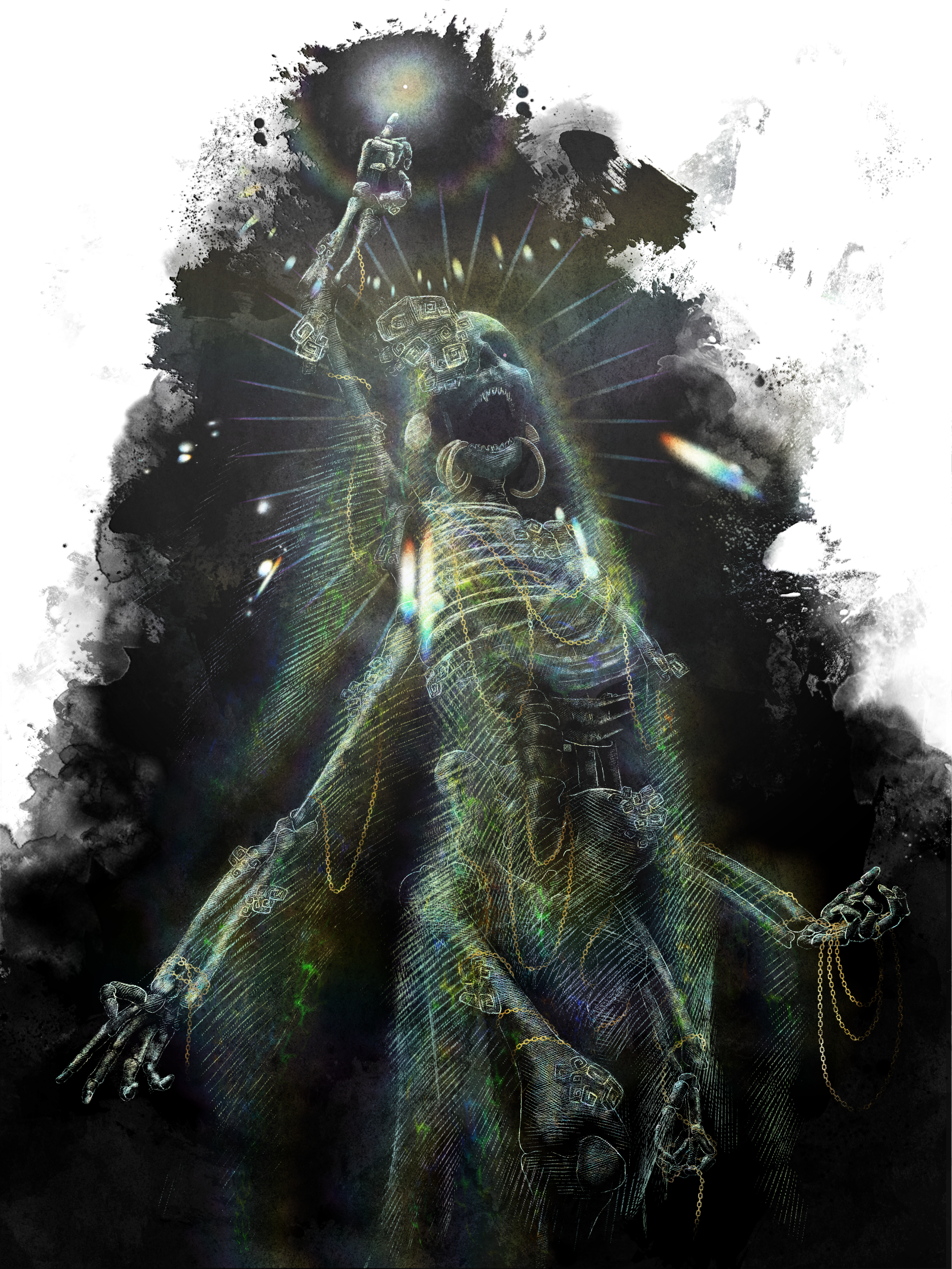
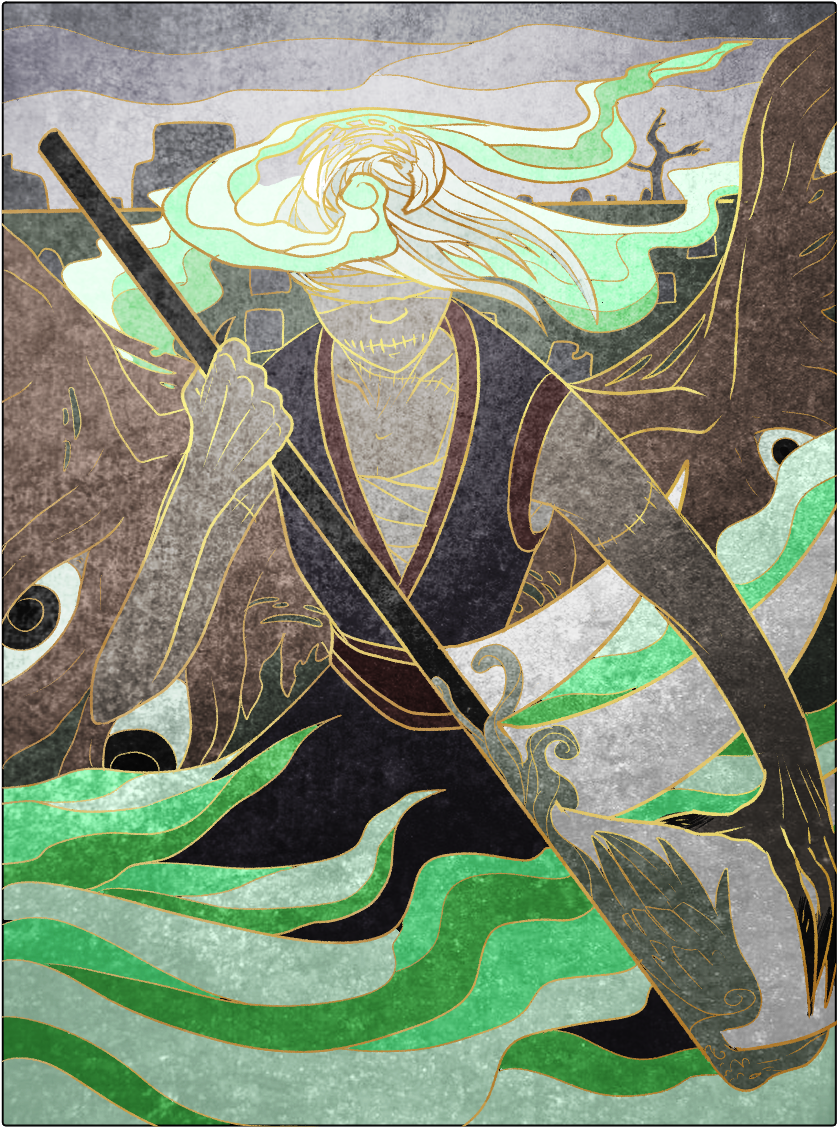
Evermore appears as a gaunt, desecrated corpse of a dusky-skinned humanoid, sometimes depicted as a oemeo. A pair of large wings with fleshy 'feathers' covered in eyes come from their back, and a broken pair of horns grow from their head and form into a sort of shattered 'halo' above their white hair. Their mouth is always sewn closed, and their normal eyes are always covered with a cloth or also sewn closed. They are depicted as carrying a three-bladed scythe decorated with raven motifs. Their dry, withered flesh is covered in stitches.Personality
To almost everyone, Evermore has no personality - instead, they are a mindless automaton who knows only to collect souls and otherwise does not act in any sort of self-interest or on any sort of personal will. It is more or less universally believed that Evermore does not have a will or personality of its own, and that they may ultimately just be a extension of Finseute's power or will.Some followers of Evermore or other death gods like Nal-Hvim and Kōraulokha-kē-Nōwawa, however, behave as though Evermore has genuinely spoken to them. Most assume this is a poor interpretation or communication of the vague sense of duty and responsibility Evermore may impart to followers, instead of full-on communication or anything that would imply that Evermore has a personality.
Powers & Domain
Evermore is the only 'true' reaper on Aanrah - while there are other gods with the domain of death, Evermore is the one with the 'final say' on souls, and the only one in control of the 'afterlife' or the way in which souls function. They are capable of giving out the ability for other reapers to collect souls, but only so far in as being substitutes to talking to Evermore themself on the Endless River, serving instead to fulfill their own religion's versions of death and the passage on. In the end, all the souls of those who have died on Aanrah end up in Evermore's claws - including those Evermore has no ability to interact with, like those of the Nuríian.Though unshown, Evermore has the ability to reap anything - including fellow deities - with little to no effort. Having the foundation of all souls on Aanrah and being deeply tied to divine aspect, Evermore can unravel and pull other beings tied to this apart, including removing specific aspects or domains.
Though unknown to now all other divine, Evermore isthe afterlife - souls of the departed are either 'stored', or are 'ironed out' to be sent back into the world by the resetting of a soul's divine aspect (see Evermore - Gestalt). This is not always perfect though, as some lives may impart a aspect so strong that, like metal, it can never be truly worked out, which has lead to the only signs and events that have lead to the theories of reincarnation on Aanrah.
History
Though Evermore's ancient and pre-Aanrah history is ultimately forgotten and lost, Evermore came to Aanrah with Eiylsweir (later to be remembered as Finseute) as one of the First Gods. Though it fielded its thoughts mostly to Eiylsweir, Evermore was the one to have created souls and the mechanics in which life and death would function in the world, though this would be historically remembered and attributed to Finseute. It and Eiylsweir had desired a world that could balance the disparate side of 'good' and 'evil' they had seen in realities beyond, with Evermore and Eiylsweir acting as a ultimate scale to balance what was supposed to be Peurma and Seusin†.Ultimately though, Eiylsweir would make a bet in secret with Finseute and then lose it, giving Finseute the opportunity to swap their positions and the chance to try to write Eiylsweir out of reality. In a panicked last-ditch effort to save himself, Eiylsweir successfully reached out to his sibling - but while Evermore was capable of holding onto a fragment of Eiylsweir, he was largely lost. Eiylsweir became the Ungod, and even Evermore forgot his existence and came to believe Finseute instead was their sibling. But Finseute did not have Eiylsweir's memories, and Evermore immediately picked up that something strange had occurred when the being they once openly spoke to treated them like the rest of the gods - as a silent, wordless automaton. Though Evermore could not place what could have possibly changed, it allowed its facade to become its 'personality' to even their 'sibling', feeling as though something about it and Eiylsweir's plan had already become compromised. And so, Evermore became a mindless automaton to the world, a divine extension of Finseute who's purpose was to reap the souls of the dead and nothing more. Evermore watches in silence, biding its time as Finseute spirals further and further away from the being Evermore once knew. It awaits the day for the puzzle to fall into place so it can set the world right again, in whatever form or fashion that must take.
Religion & Dogma
Order of Judgement
Evermore has a odd placement in the Order of Judgement. While technically formally recognized as one of its gods and as a greater god within it next to Finseute and Nuota, Evermore is rarely considered more then a extension of Finseute - often, Evermore is considered to be the executioner to Finseute's judge and Nuota's jury. For (timeframe), Evermore did have a few formally dedicated bands of followers under the Order and specific places of worship, but eventually Moem took over the role as the Divine Order's canon reaper.In modern times, Evermore exists as a background figure largely, rarely considered a 'formal' deity. Any place in which the Order would call upon or refer to a death god or grim reaper goes to Moem, and Evermore sits instead as a sort of esoteric portion of Finseute most commonly called upon in mythology and legend then as the actual true grim reaper.
A few hedge churches and sects still exist to Evermore within the Order though, even though they are often considered outside the faith or even heretical or blasphemous by other Order officials. Worship of Evermore directly is usually kept hushed in locations that follow the Order or the Church of Virtues & Blessings, outside of a handful of shrines and altars to Evermore in places of burial. Worship or belief that Evermore is its own deity or that it may have its own will is considered heresy.
Common Pantheon
Worship of Evermore in the common pantheon is fiercely debated and a hot topic in some parts of the world. In some areas beyond the Order and Church's reaches, worship of Evermore is permissible and treated as worship of any other non-antagonistic god. Evermore's followers and places of worship most often serve as or in conjecture with a local area's end of life services. They are encouraged to work with the local belief and expectations for the dead, and do not have specific charges related to this. Followers of Evermore believe simply that, in the end, all will return to Evermore in some fashion, and that death is simply another stage in the cycle of the world. They tend to be non-confrontational, and are taught to aid but to not push, especially when not welcomed. They are usually recognized by their simple dark blue or grey robes. Raven and eye motifs are common symbology among them. On contrary to popular belief, they are not exceptionally anti-undead or necromancy, though there are a few orders under Evermore's name dedicated to hunting down souled undead like liches who they claim have 'actually escaped their due judgement.'A handful of Evermore worshippers claim to be given orders or to have spoken to Evermore itself, but most assume this to be a misunderstanding of general, vague 'desires' given by Evermore (and in the Order's opinion, thus, by Finseute), or simply part of their imagination.
In many other places around Aanrah, worship of Evermore is explicitly banned. Even outside of the Order's opinions and thoughts on the matter, Evermore is seen as a inherently antagonist god as the greater god of death, and it is believed that worshipping a death god is inviting ill fortune at best or actively seeking harm at worst. While not all death gods may be banned in these locations, Evermore's unnerving lack of personality and very clear superiority in power over all other gods, no matter what the Order may argue, has made Evermore a figure to be feared.
Artifacts, Etc.
- End - Scythe - A name given to Evermore's scythe. It is thought to be able to kill anything on contact, thought it has never been seen wielded by anyone but Evermore. It is the same artifact as Gestalt Evermore's oar/pole, for what it's worth.
Relationships
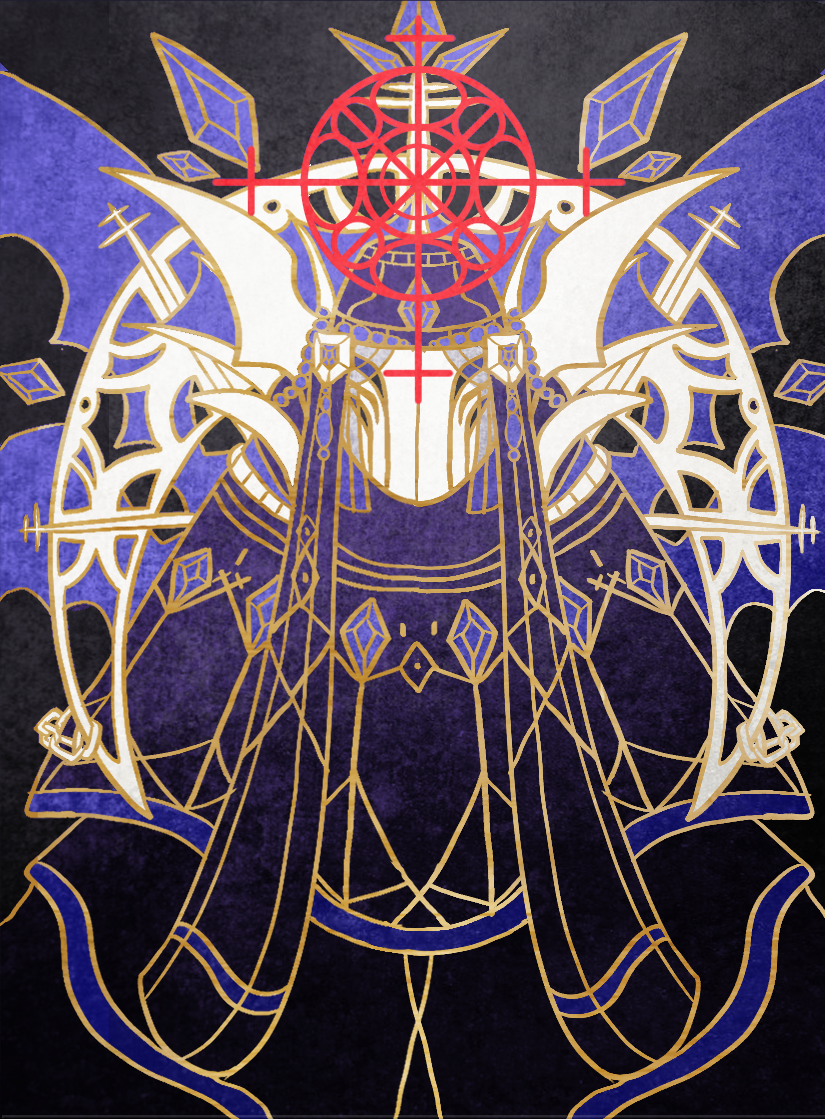
by necrowmancer
Eiylsweir
'Brother' (True)Evermore's 'real brother', Eiylsweir came with Evermore from a far away land before Aanrah was even created. Evermore hoped for a brighter world then what they had known, but did not have the same outgoing and natural charisma (or confidence) Eiylsweir had. Evermore trusted Eiylsweir implicitly, and let him do the speaking for them.
After Finseute switched with Eiylsweir, the corruption Finseute brought on reality made even Evermore believe that Finseute was their brother, and the real Eiylsweir fell between the cracks. Though Evermore quickly caught on that something was amiss with Finseute, they could not place what, and could not place that Eiylsweir was the face they used to know. In the millennia since, Evermore and Eiylsweir have crossed paths only a few times, and though something pulls on the edge of both of their consciousnesses, neither can place what it is, or why.
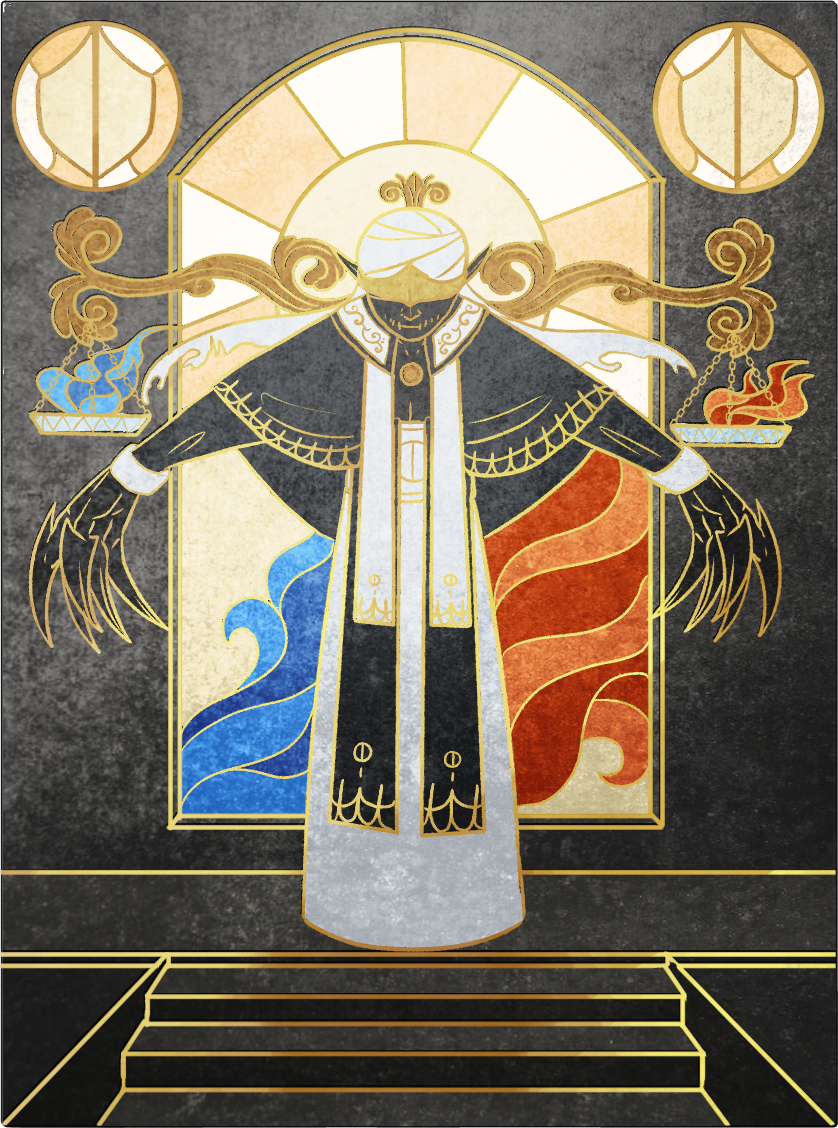
by Necrowmancer
Finseute
'Brother' (Fake)Evermore's 'brother' as far as the world can remember and knows. Though Evermore still is not sure what exactly is going on, Evermore is certain that Finseute is not the brother they once knew, and waits in painful silence in hopes of one day finding the truth. Evermore despises Finseute. Though they ultimately have to still believe that Finseute is still Eiylsweir and the deity they came to Aanrah with, it tears at Evermore to feel such hatred for the one they thought they could trust and love. But Finseute does not treat Evermore like Eiylsweir ever did - instead, Finseute treats Evermore like a object, a personal weapon devoid of its own personality, thoughts, or will.
Though it hurts them, Evermore desires nothing more then to tear Finseute apart for ultimately going back on everything 'they' had originally planned. It waits patiently for the day when it can fulfill its promise with Eiylsweir to be the true, final arbiter of judgement and justice on Aanrah.
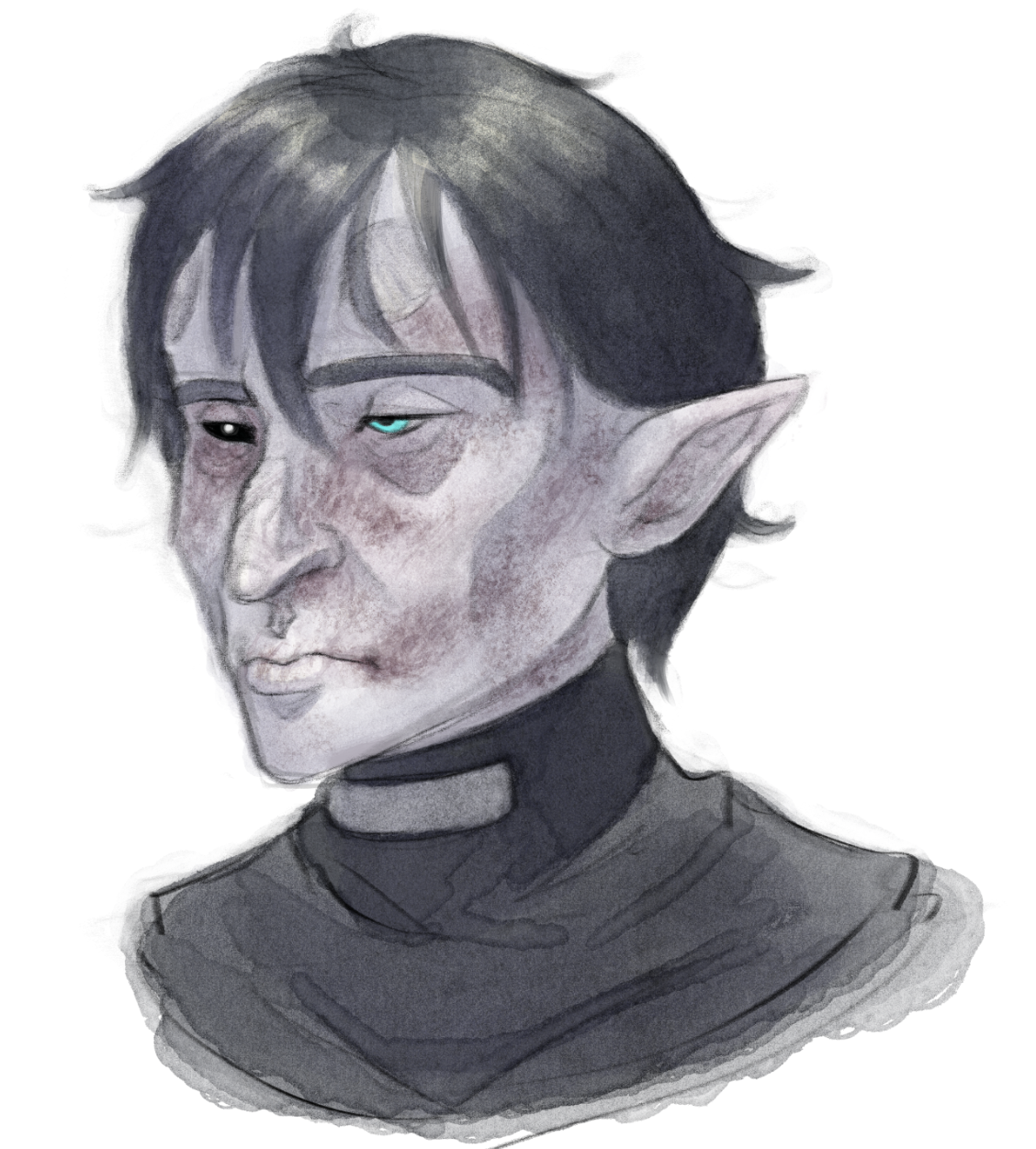
by Necrowmancer
Orpheus Abel
MistakeThe only being to have ever honestly and truly escaped Evermore's grasps, Orpheus is a unusual, painful mistake that Evermore cannot bring itself to face.

Extra
- x
"Until your heart turns to dust,
Closing in towards the moon’s halo.
Leading you by the hand,
Silently to sleep"
☒
Closing in towards the moon’s halo.
Leading you by the hand,
Silently to sleep"
☒
Species
OemeoDomains
Death, Reaping, Souls, & the AfterlifeDivine Classification
Greater GodDivine Rank
25Religions
The Divine OrderOrder of Judgement
Common Pantheon
Alignment
True NeutralCurrent Status
AliveDate of Birth/Creation
UnknownOrigin
Fledgling DeitySex/Gender
Neither/GenderlessSpouses
NoneNotable Offspring
None
Children

Comments