
Wayfinder
Look mom! The wayfinders have returned! Can I go out and meet them? I can't wait to hear if they found a safe way through the Cinderfir forest for us!Wayfinders are strong, agile people who ventured out into the cold wildlands to find new routes between settlements and other points of interest. They marked their path using ribbons and simple markings. Wayfinders operated in duos in the wild, needing to find their own food, water and shelter. Harsh weather and wild animals posed a constant threat. During the Cold Age, wayfinders were a respected people. They were strong, agile people with an adventuring spirit. After the Silver rain, their demand rose sharply due to the sudden expanse of habitation. However, with most essential paths already having been built, the demand for wayfinders is on the decline.
Wayfinder markings
If you are ever lost, you'll praise the heavens if you see a purple flash in the distance. It probably means there is a wayfinder ribbon somewhere, and next to it, markings of the area. Wayfinders periodically hung purple ribbons in highly visible places to mark the way they came. Near these ribbons, markings were carved to give more context. The markings usually had a simple structure, with an arrow and path symbol to show the direction of travel. If a wayfarer found a dead end, they'd come back and alter the symbol. Shelters, too, are marked by a pink ribbon and a symbol. For dangerous terrain and animals, a circular symbol was used to stand out from the angled route symbols. Red and blue ribbons were used in places where extra care is required. Below a few of the most used symbols are schematically shown: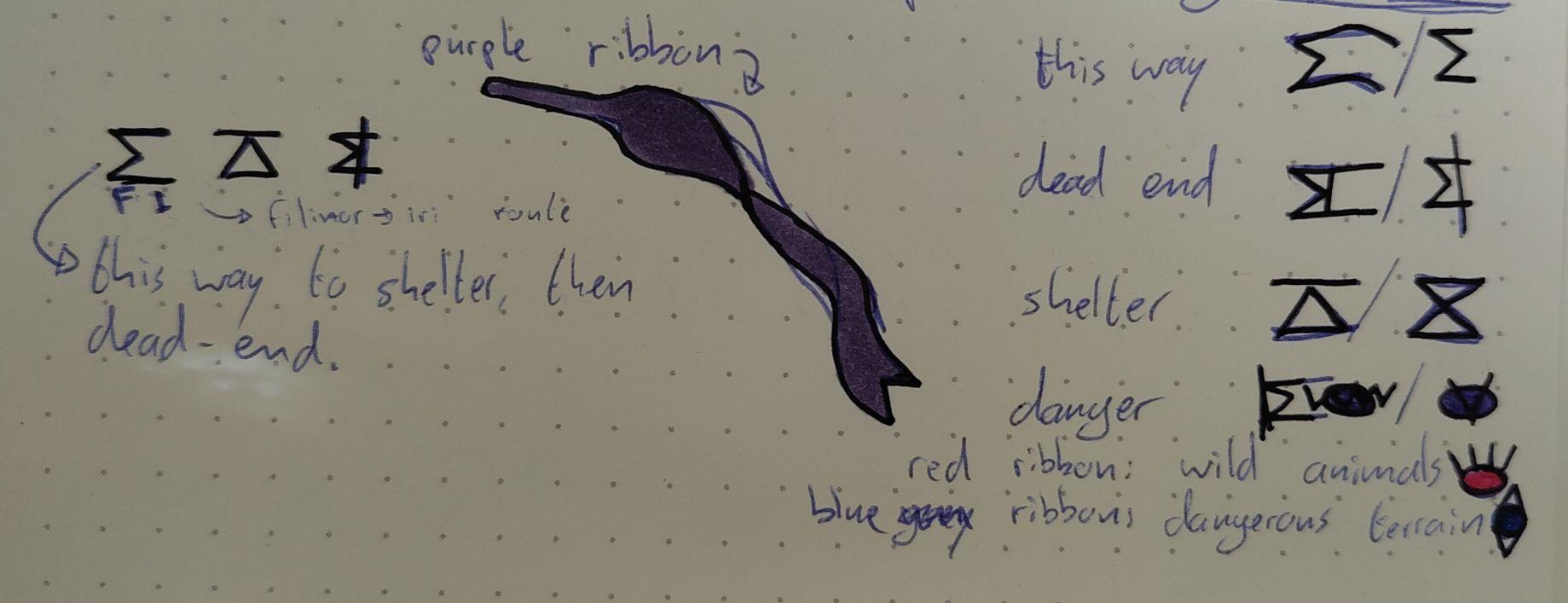
True wayfinders and Pathmakers
True wayfinders
True wayfinders are those who venture out into truly unexplored territory. Locating paths that no one had before. True wayfinders have gained high esteem and standing and are paid highly. However, their demand is declining since the silver rain, due to the warming weather, and the fact that most essential paths are already in place. Besides the obvious survival equipment, wayfinders always carried a smokestack and a horn. This way, they could signal whenever they got into too much trouble or got separated from each other. Wayfinders always operated in duos with complementary skill sets. On rare occasions, they formed trios. This reliance and dangerous work naturally resulted in a close bond between the two, with frequent intimacy, although they rarely formed monogamous relationships.Optimising runs
When the wayfinders have found a suitable connecting path, they usually rest a while. Then they return and optimise the path. They prepare the route with simple shelters and clearer markings. This is slightly less dangerous, often used to train new wayfinders.Wayfinder equipment
- A partner
- Weapons of choice
- Firestarter kit
- Water and dried foods
- Traps and other food-gathering methods
- Sleeping equipment
- Smoke pack and horn
- Knife and other simple carving tools
- Ropes
- Huge stack of purple, red and blue ribbons
- Red and blue dye
Pathmakers
After a path has been found, optimised, marked and prepared, people would call for pathmakers to finish the job. They make the path accessible for most able-bodied travellers. Pathmakers worked in small groups (4 to 8) of strong people with a knack for construction. A true wayfinder usually tagged along with this group. The job of the pathmakers is to actually Build the roads. The job of the wayfinder is to guide, protect and provide for the pathmakers. Allowing them to work more efficiently. When the need arises, however, a pathmaker is highly capable of fending off any dangers using whatever tool they happen to be holding. The pathmakers follow the route - aided by the wayfinder - and chop trees, clear debris, cut boulders and level the path. The simple shelters along the way are fortified and made easy to find. Pathmakers use the terrain around them to build the paths, cutting trees and shaping stones as they go. This prevents them from having to carry too many materials. It also results in the path feeling quite natural and diverse, as it changes throughout depending on what's available.Pathmaker equipment
- Weapon of choice
- Firestarter kit
- Water and dried foods
- Sleeping equipment
- Knives
- Axe
- Saw
- Chisels
- Hammer
- Machete
- Pick
- Sharpening tools
- Lots of rope
- Deck of cards
Career progression
Most wayfinders first start as pathmakers, then they tag along on a few optimising runs, before becoming true wayfinders. However, most pathmakers have no desire for the long, cold, dangerous and lonely lifestyle of a wayfinder. They prefer the siblinghood of hard but valued labour.- Ability to survive out in the wild
- Dealing with solitude
- Knowledge of terrain
- Physical strength and agility
- Combat skills to fend off wild animals

Comments